Lucretius Quotes
So potent was religion in persuading to evil deeds.
Lucretius. De Rerum Natura. Translated by W. H. D. Rouse, Harvard University Press, 1924, p. 11.


This is an interesting quotation as it shows that there were opponents of literal interpretation of the Bible in the 17th century, and that they were among the leading men of the day. The argument that the Bible has divine inspiration but was written by men and should not be taken literally, has been made since the Ancient Jews received the Bible.


This quotation is sometimes used to show that Washington thought religion important. Most of the founding fathers thought religion both important and potentially dangerous. They had observed Europe tear itself apart over religious differences. Note that Washington uses the words “religious principles” as opposed to “religion” or “religious prescriptions” or “religious doctrine.” The founders were not hostile to the concept of religion—even Jefferson and Franklin saw potential values in religion and religious institutions. They were hostile, however, to letting any particular sect dominate the religious environment of the nation. Nor did they want any of the religions controlling or operating the civil government. See {625616}.

He was one of the world’s greatest polymaths who among his other accomplishments was the “Father of Sociology” and was the leading Islamic intellectual of his era.

Bashir advocates adapting Sharia—Islamic Law—for all people in Indonesia—regardless of their religion or their preference for separation of church and state. This is diametrically opposite to an Islamic Syrian poet of 1000 years ago—see {624477}. Many Muslims have become more intolerant than some of their earlier scholars. Bashir also differs from most Indonesian Muslims who have historically not shared his bigotry and intolerance.


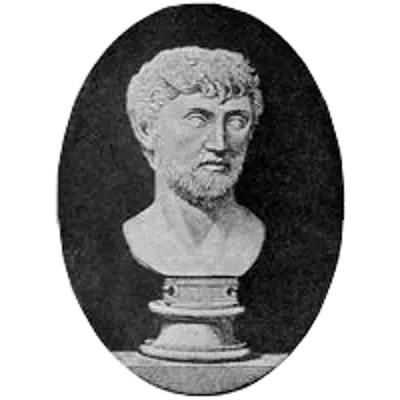
Titus Lucretius Carus (/ˈtaɪtəs luːˈkriːʃəs/ TY-təs loo-KREE-shəs, Latin: [ˈtɪtʊs lʊˈkreːtɪ.ʊs ˈkaːrʊs]; c. 99 – c. 55 BC) was a Roman poet and philosopher. His only known work is the philosophical poem De rerum natura, a didactic work about the tenets and philosophy of Epicureanism, and which usually is translated into English as On the Nature of Things. Lucretius has been credited with originating the concept of the three-age system that was formalised in 1836 by C. J. Thomsen.
