Eliot A. Cohen Quotes
Smart weapons periodically go stupid, through technical faults, jamming or spoofing….
Eliot A. Cohen, Political Scientist & Military Analyst, “5 Myths about cruise missiles”, The Washington Post, September 15, 2003
Sourced by: Eigen's Political and Historical Quotations


He anticipated smart bombs and missiles, drones, and cyber warfare. However, 25 years earlier, he observed the technology of defense and thought attacks might never again be feasible. See {626740}. Tesla was one of the great American immigrant scientists. He found in America the kind of intellectual and operational freedom that did not exist in the rigid, monarch-controlled, Austro-Hungarian Empire. He developed patents and techniques that formed the technological bases of radio, telephone long distance, TV, cell phones, Wi Fi, just to name a few. Most important he was Thomas Edison’s great nemesis. Edison invented DC electric generators that could power factories or entire streets in a neighborhood. Tesler invented and developed AC electrical technology which could power entire cities and he could move electricity over long distances which Edison could not. Tesler was one of the first scientists to conceive of and try to implement “Big Science” where there were huge capital investments to develop machines and systems to do what had never been done before—philosophically like the CERN Hadron Collider. Tesler even convinced a large corporation to finance the construction of a massive building and tower so he could experiment with the wireless transmission of electricity. However, as the industrial democracies have learned, Big Science can only be funded by governments and it often takes sever working in consort to afford the huge investment that is required. In Tesler’s era, the federal and state governments did not fund scientific research so his work was not only technically ahead of his time but also conceptually. He anticipated most of the problems and need for a national power grid that was challenging America even at the beginning of the 21st century.

over civilian casualties of American attacks The military over-promoted our smart weapons degree of capability to where most people thought that the weapons and the intelligence was much more accurate and controllable than it was. When innocent Afghan civilians were killed by American use of smart weapons, the Afghan’s believed that the only two explanations were that the Americans wanted to kill the civilians or that they didn’t care enough to carfully use their smart weapons properly.


This was a precursor of the total war views of William Tecumseh Sherman and Ulysses S. Grant during the American Civil War half a century later.

Military robots including drones are very inexpensive as military hardware goes. And like other hi-technology devices, the prices go down steadily as volume grows. Almost any government can afford to buy military robots from the U. S., France, Russia or Israel. As a result, there can be many more nations who can have a modern military, even if small. Thereafter, they can conduct modern warfare readily.


The Minister equates the unintended consequences of war and civilian casualties with a terrorist retaliation which has as its purpose the killing of as many civilians as possible. The proliferation of terrorism complicated the ethics of counter terrorism. In the case of Palestinian terrorists their tactics included using civilian facilities---schools, hospitals, homes---from which to launch rocket attacks or to store weapons or hide terrorists. Under international laws of war, a civilian facility and the civilians in it become legitimate military targets the minute that weapons are stored in or fired from that location or that location is used for planning, training, equipping or manufacturing of military material. Palestinian terrorists claim that even though civilians were harmed in legitimate, legal attacks on military targets, a proper response is to send suicide bombers into civilian areas and preparing the explosives with nails and rat poison to cause as much pain as possible.


The speech was addressed to those American imperialist forces that were supporting the war in the Philippines.
Responding to reporter’s question about colatteral enviornmental damage from the result of bombing and fires.


Churchill saw before many others that technology and weaponry had changed the nature of warfare. At the time the military leadership of all the major powers were pursuing 19th century tactics with 20th century weaponry including mass bayonet charges against machine guns behind barbed wire. Churchill and other civilians, although they had legal control over the military, had little de facto tactical control. As a politician he became an itinerant meddler in military tactics thereafter.


Mahathir, in his moral assessment, fails to come to grips with the fact that the Coalition forces in their Afghan and Iraq activities attempt to kill and injure as few people as possible to accomplish their objective. The terrorists attempt to kill and injure as many people as possible. In the September 11 attack, the buildings could have been attacked late at night so there would be few casualties, and in Bali they could have bombed the facility after it had closed instead of waiting until there was the largest audience. And the terrorist bombs include nails, rat poison, and other additional material designed not to do more building damage, but to kill and maim more people which is their specific objective. Most wars have collateral damage and the parties are required to make a good faith attempt to minimize that. But the terrorists not only make no attempt, but make strong efforts to kill as many as possible. That is a huge moral and ethical distinction.

His balanced judgment and concern for American Casualties changed during the Iraq War over a decade later where he insisted on taking steady American casualties even after Saddam had been deposed and American troops were in the middle of a sectarian civil war.
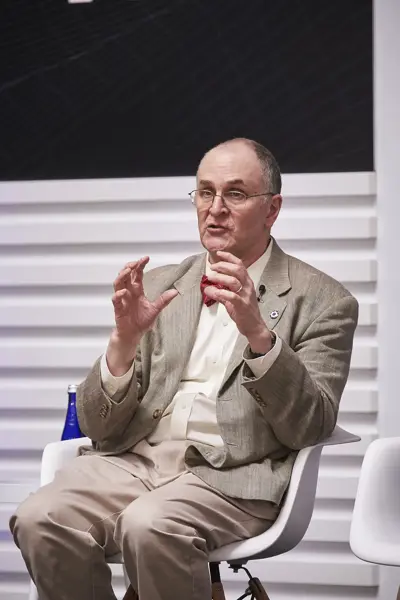
Eliot Asher Cohen is an American political scientist. He was a counselor in the United States Department of State under Condoleezza Rice from 2007 to 2009. In 2019, Cohen was named the 9th Dean of the Paul H. Nitze School of Advanced International Studies (SAIS) at Johns Hopkins University, succeeding the former dean, Vali Nasr. Before his time as dean, he directed the Strategic Studies Program at SAIS. Cohen "is one of the few teachers in the American academy to treat military history as a serious field", according to international law scholar Ruth Wedgwood. Cohen is a contributing writer at The Atlantic.
