Leonhard Euler Quotes
Since the fabric of the universe is most perfect and the work of a most wise Creator, nothing at all takes place in the universe in which some rule of maximum or minimum does not appear ... there is absolutely no doubt that every affect in the universe can be explained satisfactorily from final causes, by the aid of the method of maxima and minima, as it can be from the effective causes themselves ... Of course, when the effective causes are too obscure, but the final causes are readily ascertained, the problem is commonly solved by the indirect method.
Euler, Leonhard. Methodus inveniendi lineas curvas maximi minimive proprietate gaudentes. Marc-Michel Bousquet, 1744, p. 245.


Voltaire was also an amateur scientist and was familiar with the new physics of Newton. His mistress, was one of the best scientists in France and the translator of Newton into French. Voltaire marveled at the logic that drove the universe and assumed that there must have been a prime mover. At the same time, although believing in God, Voltaire, like many other intellectuals of the time, were major enemies of organized religion in general and the Catholic Church in particular. See {621191} .

This quotation is very interesting with reference to the modern debate about teaching creationism in the public schools. Two hundred years before, Shelly observed that before we can debate as to who was the designer, we must first prove that there was a design. He was skeptical, and this was before Darwin and modern astronomy. Today there are physicists who have shown how the Big Bang might have taken place without any plan, design or creation. And evolution explains how mankind and other life forms may have evolved without any specific species management or design.


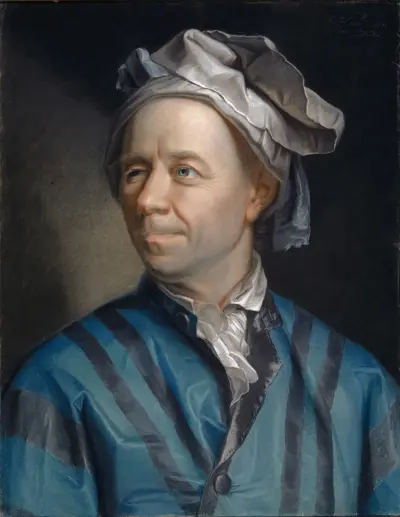
Leonhard Euler was a Swiss mathematician, physicist, astronomer, geographer, logician and engineer who made important and influential discoveries in many branches of mathematics, such as infinitesimal calculus and graph theory, while also making pioneering contributions to several branches such as topology and analytic number theory. He also introduced much of the modern mathematical terminology and notation, particularly for mathematical analysis, such as the notion of a mathematical function. He is also known for his work in mechanics, fluid dynamics, optics, astronomy and music theory.
