Voltaire Quotes
She is a great man whose only flaw is that she is a woman.
Gabrielle Émilie Le Tonnelier de Breteuil, Marquise du Chatelet, 1706-1749 was a great French Physicist & Mathematician at a time when females rarely knew anything of these subjects. She was the first scientist to predict infra-red radiation and she translated Newton’s Calculus into French and at the same time developed some new proofs. Perhaps her greatest achievement was her discovery and proof that the energy of a moving object was not proportional to its velocity as had been claimed by Newton and all other scientists of the say. She showed them that it was proportional to the square of the velocity. She was a bit of a libertine and had an affair with Voltaire among others. Tragically, she died in childbirth at the age of only 43.
Voltaire, 1694-1778, [Francois-Marie Arouet], French Historian & Dramatist, Description of Emilie du Chatelet
Sourced by: Eigen's Political and Historical Quotations


Scientist and double Nobel Prize winner, Marie Curie, 1867-1934, was rejected for membership at the French Académie des Sciences. She never allowed her name to be submitted again and for years refused to allow her work to be published by the Académie.


Golden was one of the leading theater producers of the 1920s and 1930s. There is even a theater on Broadway named after him. This statement reflects a common attitude of the late 1930s of even many educated people. A few like Eleanor Roosevelt saw such a statement for what it was—ridiculous and responded publicly – {636785} . Note that for many years, this was a self-fulfilling statement. Producers like Golden thought women could not be great playwrights and therefore would never produce a play authored by a woman. Then others would use the fact that there were no even good plays that were written by female authors as evidence of the act that women could not be great playwrights.


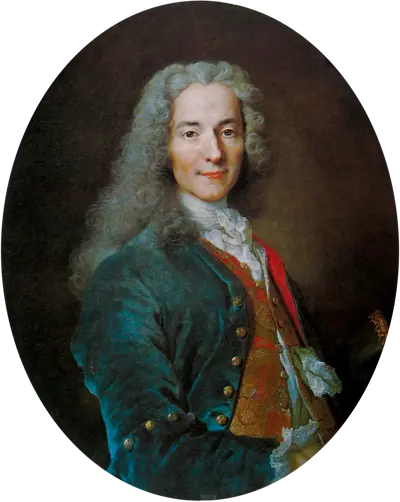
François-Marie Arouet, known by his nom de plume Voltaire (/vɒlˈtɛər, voʊl-/; also US: /vɔːl-/; French: [vɔltɛːʁ]), was a French Enlightenment writer, historian, and philosopher famous for his wit, his criticism of Christianity—especially the Roman Catholic Church—as well as his advocacy of freedom of speech, freedom of religion, and separation of church and state.
