Eoin Colfer Quotes
She can't afford to commit more troops,' Holly whispered. 'The gate is her priority, and she needs to have as many Berserkers watching her back as possible. We are secondary at this point.' 'That will be her undoing,' Artemis gasped, already suffering under the weight of the flak jacket. 'Artemis Fowl will never be secondary.' 'I thought you were Artemis Fowl the Second?' said Holly.
Colfer, Eoin. Artemis Fowl: The Last Guardian. Disney Hyperion, 2012.


The General had differed with the George W. Bush Administration neoconservatives over the strategy regarding the invasion and war in Iraq. He was pushed out of office as a result. Later, it was clear that he was right originally, and the press, some members of Congress and others wanted him to comment. He refused.


He polished the army but had little strategic appreciation for the strengths of the Union, its industrial capability, logistical capability, and its greater manpower pool. He was reluctant to fight, and when he did, was happy to take territory, that meant little, when Lincoln and other strategists argued that the object should be to destroy and degrade the Confederate Army and the Confederate capacity to support the Army and continue to make war.

The General refused. He had already achieved a strategic victory and it was only a matter of time when the Dutch would withdraw on their own as their supply lines were cut off and the populations wanted them out.

A Federal Naval flotilla was preparing to attack South Carolina Forts Beauregard and Walker in the area of Hilton Head and Port Royal. The navy took both forts the next day with their naval bombardment so powerful that the Confederate Rebels had to abandon both forts gaining a kind of revenge for the Confederate capture of Fort Sumter at the war’s beginning.

He was leading the Gordon Highlanders of the British Army against the Boers during the Boer War. He was seriously wounded and could not go on himself with a charge he had ordered, However, waifing his sword he made this famous qutation. Particualrly noteorthy is the derrogatory terms which he used to describe the enemy--the Boers of South Africa. In many wars and cultures, one or more of the combatants, in order to overcome the avarage soldier's reluctance to kill an enemy, characterizes them as less than human. In this case, vermin, who were to be exterminated. There were two predominant groups of whites who came to South Africa, the English who were generally well-educated and were interested in trading with the exhisting inhabitants and investing in businesses using mostly native labot and the Boers. The latter were of Dutch and German origin, poor farmers with little or no land in the home country and little education. Their interest was to create a nation where they could own land to farm. And the lest expensive way for them to increase their farmland was to sieze it from the native Blacks and who were the major forces behind the racial discrimination which became apartheid. The British contolled the government and sought stability and as in most of the British Empire, they wanted English law to prevail including the rights of the Black natives. The Boers had left Europe for good and would thrive or not in Southern Africa. Proportiopnately, the English might have a career in South Africa or serve there for a few years. They were Englishmen in a foreign country. The Boers saw themselves as citizens of Southern Africa who were fighting the native Blacks for control of the land. The English legal system would not allow any of the land seizures and political discrimination that the Boers saw as existential for their survival in Africa. Soon, the Boers took more and more of the law into their own hands and saw English rule and dmination as inimical to their interests in Africa and they tried to create their own independent states in Southern Africa. That was the essense of the Boer Wars. Dick-Cunyngham was awarded the Victoria Cross, the highest military decoration of Great Britain, for his exploits in the Afghan War.


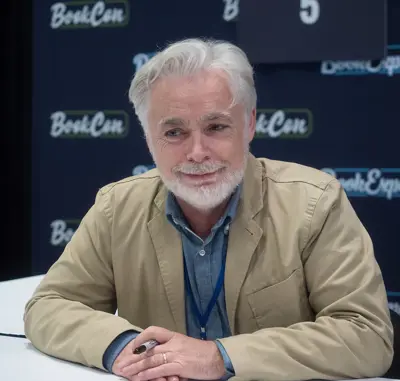
Eoin Colfer is an Irish author of children's books. He worked as a primary school teacher before he became a full-time writer. He is best known for being the author of the Artemis Fowl series. In September 2008, Colfer was commissioned to write the sixth instalment of the Hitchhiker's Guide to the Galaxy series, entitled And Another Thing ..., which was published in October 2009. In October 2016, in a contract with Marvel Comics, he released Iron Man: The Gauntlet. He served as Laureate na nÓg (Ireland's Children's Laureate) between 2014 and 2016.
