Henry Taube Quotes
Science as an intellectual exercise enriches our culture, and is in itself ennobling. ... Though to the layman, the world revealed by the chemist may seem more commonplace, it is not so to him. Each new insight into how the atoms in their interactions express themselves in structure and transformations, not only of inanimate matter, but particularly also of living matter, provides a thrill.
Taube, Henry. "Banquet Speech." Les Prix Nobel. The Nobel Prizes 1983, edited by Wilhelm Odelberg, Almqvist & Wiksell International, 1984.


This is almost the universal belief of scientists—religious or not. The faith of religion, if extended to science, does not give the person the tools of logic, empiricism, and deduction that is so critical for the scientist. The cleric, in contrast, requires faith. Politicians split. There are many who have the outlook of the scientist. However, there are also political ideologues, who want faithful adherence to the doctrine, as the theological leaders does, and does not subject the doctrine to analytic scrutiny.


In politics, a person who flip flops is suspected of not having principles. In science, a person who does not flop flop is suspected of not being scientific. As new evidence amasses, the scientific method requires that the scientist chenges. The politician is often expected to hold to his principles regardless of new or contrary evidence.


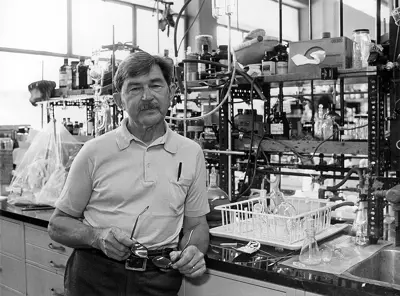
Henry Taube, FRSC was a Canadian-born American chemist noted for having been awarded the 1983 Nobel Prize in Chemistry for "his work in the mechanisms of electron-transfer reactions, especially in metal complexes." He was the second Canadian-born chemist to win the Nobel Prize, and remains the only Saskatchewanian-born Nobel laureate. Taube completed his undergraduate and Masters degrees at the University of Saskatchewan, and his Ph.D from the University of California, Berkeley. After finishing graduate school, Taube worked at Cornell University, the University of Chicago and Stanford University.
