Plutarch Quotes
Rome was in the most dangerous inclination to change on account of the unequal distribution of wealth and property, those of highest rank and greatest spirit having impoverished themselves by shows, entertainments, ambition of offices, and sumptuous buildings, and the riches of the city having thus fallen into the hands of mean and low-born persons. So that there wanted but a slight impetus to set all in motion, it being in the power of every daring man to overturn a sickly commonwealth.
Plutarch. Plutarch's Lives. Translated by John Dryden, edited by Arthur Hugh Clough, vol. 4, Little, Brown, and Company, 1859, p. 196.


This was his most famous speech.


After Roosevelt, most eras of American politics more or less followed the pattern Roosevelt described herein as a “calamity”, with the anger becoming more or less intense. Jefferson thought that these were natural divisions of politics in all societies--{604810}. The thing that masked this for years was race and slavery. In Lincoln’s time there were liberals and conservatives in both parties if race were ignored. In Theodore Roosevelt’s era, he, Taft and others were generally liberal reformers, while a large number of Republicans were conservative supporters of the status quo. Some democrats were radical reformers like William Jennings Bryan while others were arch conservatives. Until 1964 and the Civil Rights Act there were many conservatives in the Democratic Party, but almost all switched to the Republican Party in anger. The Republican conservatives tended to drive the Republican liberals out of the party and for the last part of the 20th century Roosevelt’s “calamity” well described the American political scene, and the anger increased carrying partisan bitterness into the 21st century.


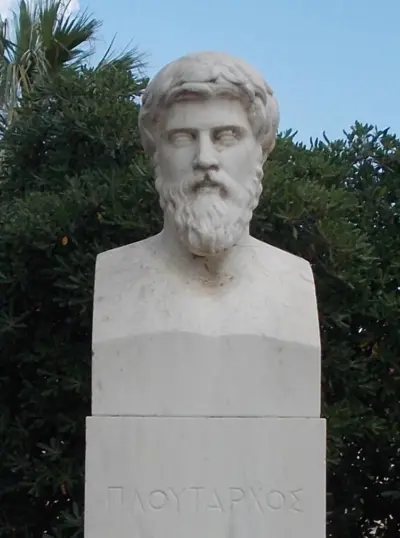
Plutarch (/ˈpluːtɑːrk/; Greek: Πλούταρχος, Ploútarchos; Koine Greek: [ˈplutarkʰos]; AD 46–after AD 119) was a Greek Middle Platonist philosopher, historian, biographer, essayist, and priest at the Temple of Apollo. He is known primarily for his Parallel Lives, a series of biographies of illustrious Greeks and Romans, and Moralia, a collection of essays and speeches. Upon becoming a Roman citizen, he was named Lucius Mestrius Plutarchus (Λούκιος Μέστριος Πλούταρχος).
