Thomas More Quotes
Restrict the right of the rich to buy up any anything and everything, and then to exercise a kind of monopoly.
Thomas More, 1478-1535, Speaker of the House of Commons, Lord Chancellor of England, Utopia
Sourced by: Eigen's Political and Historical Quotations


In modern America, there are two political views of this notion. The one held by a small majority of the population is Trenchard’s quotation taken literally. Their view is that there if the is no way to maintain liberty if there is too wide a gap between the rich and the rest of the population. The second variant, held by many conservatives limits the equality to equality of opportunity. They are loathe to take any position that says that any gap between the rich and the remainder of the citizens might be too large. They would particularly disagree with the first sentence of another Trenchard quotation, {627024}.


Writing about the railroad magnates and monopolists of his day:

Many of the richest people continue to acquire more money via illegal and immoral means. See {630537}.


Webster was taking regular bribes from large corporations and even complained when his payments were late. So he might have had a pro-large business bias. At the time taking bribes even if there was a quid pro quo was not illegal or even “unethical” by then Congressional rules.

The Banks and Wall Street were much to blame of the Great Depression which began in 1929. Many called for reform and heavy regulation of the finance industry. However President Hoover was very passive and the Depression became worse. Hoover also opposed ANY regulation of banking or Wall Street. Hence the names in this quotation. The Priest was the right wing demagogic radio host of his day. Virulently anti-Semitic and anti-Black, he was threatened with excommunication by the Catholic Church, which finally ordered him to cease us weekly radio show and stop the political hate.


Abrams originated this famous phrase which many have been used subsequently for various “socialized” government benefits that were available to the rich but not the poor. He was referring to the fact that at the time, the government provided housing assistance to the rich by having federally insured mortgages and granting tax deductions for the interest in home mortgages, but there was no assistance to the poor who could only afford to rent and had no tax deductions nor was there any federal public housing assistance. During the Great Recession the phrase was often used when the government gave bail out money to General Motors and the largest banks who were close to bankruptcy, but the landscaping gardener or the hot dog vendor whose business was falling because of the recession were told that is the capitalist system—there are some winners and some losers. The government officials who advocated the bailout did not disagree about the fairness and appropriateness of the Abrams phrase but if they had not bailed the banks out, the entire economic system of the country would probably have collapsed and the ensuing depression would hurt the average worker and the poor even more. Related to the recent “too big to fail” concept.


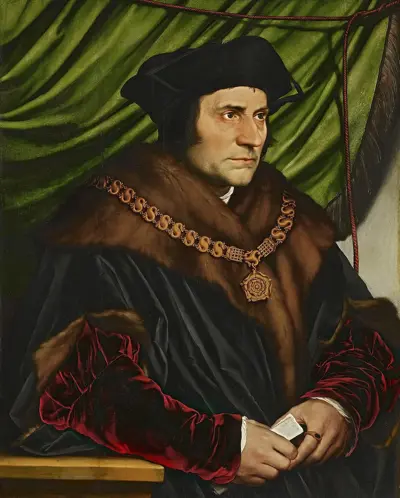
Sir Thomas More, venerated in the Catholic Church as Saint Thomas More, was an English lawyer, judge, social philosopher, author, statesman, and noted Renaissance humanist. He also served Henry VIII as Lord High Chancellor of England from October 1529 to May 1532. He wrote Utopia, published in 1516, which describes the political system of an imaginary island state.
