Charles Kettering Quotes
Research is industrial prospecting. The oil prospectors use every scientific means to find new paying wells. Oil is found by each one of a number of methods. My own group of men are prospecting in a different field, using every possible scientific means. We believe there are still things left to be discovered. We have only stumbled upon a few barrels of physical laws from the great pool of knowledge. Some day we are going to hit a gusher.
Kettering, Charles F. Prophet of Progress: Selections from the Speeches of Charles F. Kettering. Edited by T. A. Boyd, E. P. Dutton, 1961.


In the French Revolutionary reign of terror, people were settling old scores and denouncing anyone they had an issue with as anti-revolutionary. And nobility were extremely suspect. Antoine Laurent Lavoisier (1743-1794) was not only a great scientist but a wealthy noble who also was an expert on government finance and had served as a tax collector. Lavoisier’s defense was that he could finish his scientific experiments that the whole world could benefit from. Ironically, 3 months after Lavoisier was beheaded, the judge himself was denounced by an enemy and he too was sent to the guillotine.


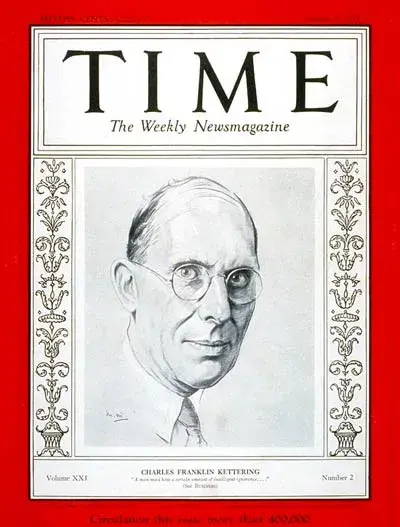
Charles Franklin Kettering sometimes known as Charles "Boss" Kettering was an American inventor, engineer, businessman, and the holder of 186 patents. He was a founder of Delco, and was head of research at General Motors from 1920 to 1947. Among his most widely used automotive developments were the electrical starting motor and leaded gasoline. In association with the DuPont Chemical Company, he was also responsible for the invention of Freon refrigerant for refrigeration and air conditioning systems. At DuPont he also was responsible for the development of Duco lacquers and enamels, the first practical colored paints for mass-produced automobiles. While working with the Dayton-Wright Company he developed the "Bug" aerial torpedo, considered the world's first aerial missile. He led the advancement of practical, lightweight two-stroke diesel engines, revolutionizing the locomotive and heavy equipment industries. In 1927, he founded the Kettering Foundation, a non-partisan research foundation. He was featured on the cover of Time magazine on January 9, 1933.
