Leonard Susskind Quotes
Physics is perceived as a lonesome, nerdy kind of enterprise that has very little to do with human feelings and the things that excite people day-to-day about each other. Yet physicists in their own working environment are very social creatures.
Susskind, Leonard. The Black Hole War: My Battle with Stephen Hawking to Make the World Safe for Quantum Mechanics. Little, Brown and Company, 2008, p. 7.


To the general public Ballard is a star—the man who found the Titanic. Whereas he acknowledges that this has helped him raise money for science, but it has also caused him problems in the scientific community. Most important scientific work is done by teams and they depend on others who have laid the groundwork before them. Few are the Einsteins and the Fermi’s who on their own produce great scientific achievements.

Although not a scientist, Blackstone observed the advantage of an incubator, science center or other socially and intellectually interactive structure and realized that the cliché of a scientist alone in his laboratory was not the optimum environment in which science would flourish.

He was arguing against the point of view that military success in the future will depend on technology.

Although Einstein never accepted the political positions offered to him, had had many of the skills of able politicians including the visage he presented to cameras.

He was specifically discussing weapons research and development. However at that time the tendency for scientists to work in isolation in most fields of science was already reducing.


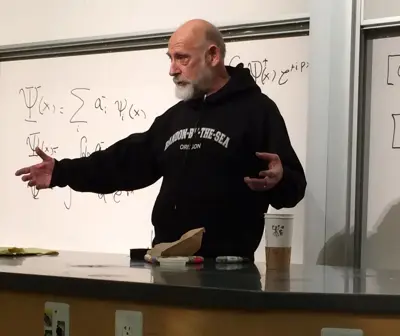
Leonard Susskind is an American physicist, who is a professor of theoretical physics at Stanford University, and founding director of the Stanford Institute for Theoretical Physics. His research interests include string theory, quantum field theory, quantum statistical mechanics and quantum cosmology. He is a member of the US National Academy of Sciences, and the American Academy of Arts and Sciences, an associate member of the faculty of Canada's Perimeter Institute for Theoretical Physics, and a distinguished professor of the Korea Institute for Advanced Study.
