Karl Marx Quotes
Pauperism is the hospital of the labor army.
Karl Marx, 1818-1883, German Economist & Socialist, Capital, 1867
Sourced by: Eigen's Political and Historical Quotations


This fascinating quotation is very frequently quoted out of context. For example even in modern times some Southern slavery apologists quote this passage stating that Adams saw no moral difference between slavery and employment of the lower classes. And anti-capitalists have claimed that this was an attack on capitalism as no better than slavery for many workers. Neither is true. The debate was on the head taxes that states should pay to the central government. Southerners were claiming that they should not have to pay per person taxes on slaves. Adams position was that they should pay in that there is no practical difference in the work and working conditions very often. If slaves should be exempted from the head tax, so should the poor, lower class workers like the fisherman in New England. He always maintained at huge moral difference between a poor free worker and a slave even thought their working conditions might be similar.


Well over a century ago, this prescient economist pointed out that in a very competitive economy, people would have to develop and have multiple skills to remain employable. The competition also produces technological obsolescence.

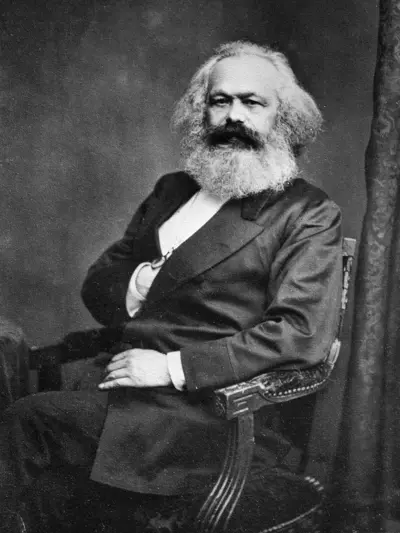
Karl Heinrich Marx was a German philosopher, economist, historian, sociologist, political theorist, journalist and socialist revolutionary. Born in Trier, Germany, Marx studied law and philosophy at university. He married Jenny von Westphalen in 1843. Due to his political publications, Marx became stateless and lived in exile with his wife and children in London for decades, where he continued to develop his thought in collaboration with German thinker Friedrich Engels and publish his writings, researching in the reading room of the British Museum. His best-known titles are the 1848 pamphlet The Communist Manifesto and the three-volume Das Kapital (1867–1883). Marx's political and philosophical thought had enormous influence on subsequent intellectual, economic and political history. His name has been used as an adjective, a noun, and a school of social theory.
