Walter Lippmann Quotes
Ours is a problem in which deception has become organized and strong; where truth is poisoned at its source; one in which the skill of the shrewdest brains is devoted to misleading a bewildered people.
Lippmann, Walter. Liberty and the News. Harcourt, Brace and Howe, 1920, p. 10.


He was asked why the War Office maintained three sets of figures: 1st Earl of Oxford

The conclusion that almost all scientists who have studied the problem of climate change and global warming us that there is a substantial change ongoing. That conclusion is reached as the result of literally thousands of observations and studies about the many aspects of climate change. Like any other science, a number of studies have flaws and there are many who fear that government funds will be used to cope with climate change at a cost to the economy. They point to the flaws of individual studies or researchers and have spent millions of dollars to produce uncertainty into the mind of the pubic and politicians. Science, however, ALWAYS has uncertainty and flaws are ALWAYS discovered in established scientific principles. It does not mean that these larger theories and principles are wrong if several of the studies or points are wrong and are understood in a larger and more sophisticated context. Einstein’s Theory of Relativity could be foolishly be called wrong because Einstein did not take account of what would become Quantum Mechanics and there were some contradictions. None the less Relativity is still the most important physical discovery of all time and influences all thinking in physics even though he could not account for the very small physics of quarks, electrons and other atomic particles.


See {115604} for a similar sentiment from England.


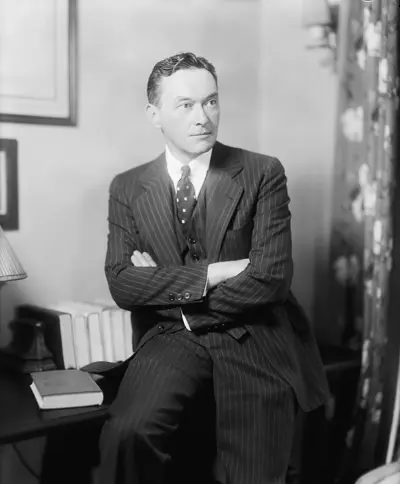
Walter Lippmann was an American writer, reporter and political commentator. With a career spanning 60 years he is famous for being among the first to introduce the concept of Cold War, coining the term "stereotype" in the modern psychological meaning, as well as critiquing media and democracy in his newspaper column and several books, most notably his 1922 book Public Opinion.
