Hubert Humphrey Quotes
Our opposition will never understand the Democratic Party. Our Party is--to the unpracticed eyes of the old Republican Tories--a mysterious contraption that usually seems to be moving in a thousand directions. What they don't know is what hurts them. For all that movement in the Democratic Party is caused by the internal combustion of creative ferment, of ideas, of people vigorously committed to the proposition that change and social progress are not only to be desired; they are necessities of twentieth-century America.
Hall, Perry D., editor. The Quotable Hubert H. Humphrey. Grosset & Dunlap, 1967.


There had been a major labor strike in the textile mills of Lawrence. Ettor was one of the major strike leaders and strategists. The city authorities sided totally with the mill owners and used police and militia to try and break the strike. When one of the strikers was shot and killed (historians generally agree that the police had fired the shot), the authorities used the death to incapacitate the leadership of Ettor and two other “socialist” leaders who were professional strike organizers and leaders. The 3 were arrested and charged with murder, firing the shot that killed the striker. Ettor and the others were miles away at the time giving speeches to the strikers at another mill. None-the-less, they were arrested, jailed, and not even tried until after the strike was ended. The three were quickly acquitted. The jailing of the strike leaders backfired and made the strikers even more resolute. The laborers finally won the concessions, not to have their pay cut. The defendants went on to lead other strikes.


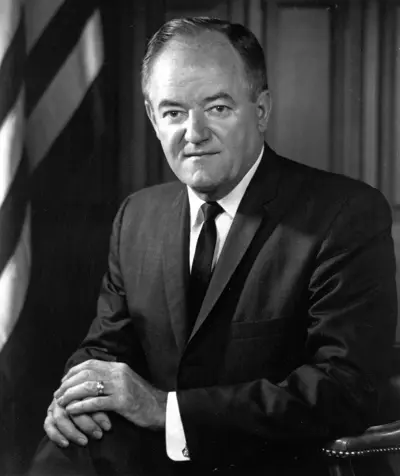
Hubert Horatio Humphrey Jr. was an American politician who served as the 38th vice president of the United States from 1965 to 1969. He twice served in the United States Senate, representing Minnesota from 1949 to 1964 and 1971 to 1978. As a senator he was a major leader of Modern liberalism in the United States. As President Lyndon Johnson's vice president, he supported the controversial Vietnam War. An intensely divided Democratic Party nominated him in the 1968 presidential election. He lost a close race to Republican nominee Richard Nixon.
