Walter Hussey Burgh Quotes
Our members are returned by the fear or dependence, not the affection or choice of the electoral body. Unaccountable for their conduct in Parliament, their venality is unrestrained and universal corruption reigns in the House.
The members of the Irish Parliament at that time were an almost permanent group. Their constituents, were uneducated, ignorant, and often dependent on the member and in fear of retribution if he were not elected. Like any legislative body of members or almost certain reelection, many of the members were corrupt and unaccountable.
Walter Hussey Burgh, 1742–1783, Irish statesman and judge, Member of Parliament, Chief Baron of the Irish Exchequer, Quoted in Wikipedia Biography
Sourced by: Eigen's Political and Historical Quotations


In the early 20th century, the corruption in America was much worse than it is today. At the time, it was very common for members of Congress and State Legilators to take bribes from corporations whose interests they protected. Franchises, subsidies and other forms of corporate welfare was much more common. The reforms of the 20th centuries eliminated much of the corruption. At the same time, Americans, including Ms. De Cleyre knew much less about the details of foreign country’s foibles and weaknesses. So she underestimated the degree of corruption of foreign nations and made her judgment from the extensive corruption that then existed in the United States.


The irony of this quotation is that he is the architect and controller of the Russian system that he is criticizing.


She was at the time the European Commissioner for Competition

No one had a majority of the Electoral College and the election was thrown into the House of Representatives. Henry Clay was the Speaker of the House, and had a grudge against Jackson. He convinced several of the State congressional delegations to vote for John Quincy Adams, and when Adams was President, he made Clay the Secretary of State, then the most powerful cabinet position. Hence Jackson’s characterization.


The United States had just ousted the popularly elected leader Patrice Lumumba {640611}, and backed Mobuto. Lumumba was an idealist who was not corrupt at all, but were not so sure about our new protégé. Sadly he turned out to be one of the worst kleptocrats of all time, and he stole with more United States money than we gave to many nations in toto. Many believe that one of the reasons, corruption of our “allied” leaders was so bad lies in the wording of this cable. Note that to the State Department writers there was “normal” corruption as opposed to excessive corruption. Once that view is taken there is a constant battle to determine whether each new act of corruption is “normal “ or not, and corruption is simply lessened by pushing back against the most abnormal schemes. These critics advocate a zero tolerance for corruption especially with United States AID money. The State Department has been ambivalent and have often used the corruption system to bribe leaders to obtain national objectives.
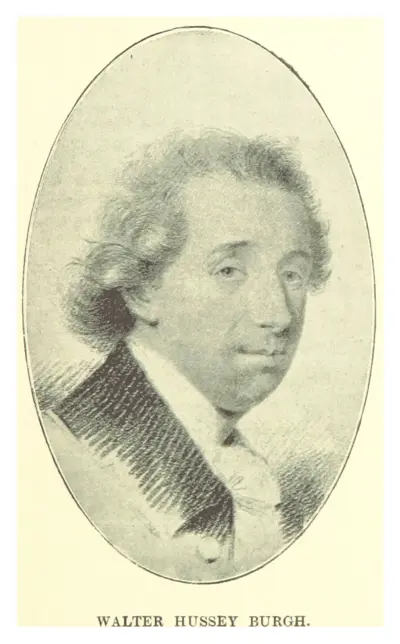
Walter Hussey Burgh (1742 – 1783) was an Irish statesman, barrister and judge; he sat in the Irish House of Commons, and was considered to be one of the outstanding Irish orators of his time. He served briefly as Chief Baron of the Exchequer in the last year of his life.
