Pericles Quotes
Our form of government is called a democracy because instead of being controlled by a monopoly, it is controlled by the whole people.
Pericles, c.495-429 BC, Athenian Statesman, 431 BC
Sourced by: Eigen's Political and Historical Quotations


As a member of the electoral college, he refused to vote for Richard M. Nixon who had won the North Carolina vote. Extremist fundamentalists often oppose democracy in favor of republicanism. A major distinction for them is in the republic, there is not direct


Although it had conservative and progressive support, there was opposition in the middle and the vote failed in the House 188 to 209. See Hamilton Fish for the amendment text.

At the time Democracy as a form of government meant citizens voting for their own laws—not their representatives. Today we call that “Direct Democracy” as in a New England Town Meeting.

His faction won on the House and lost with respect to the Senate.


the Electoral College system that we have

This is a very important quotation. Abraham Lincoln obtained a printed copy of Parker’s sermon and underlined this quotation on his copy. Later when he was President he used a slight variation of Parker’s last phrase in the last line of his famous Gettysburg Address.

He changed his views a great deal since this time when he was only 28 years old and the IRA Chief.


This was the classic, historical argument the Fascists made to justify their take over of democratic societies; the argument made by every military junta that illegally seized power; by Julius Caesar when he took control of Rome.


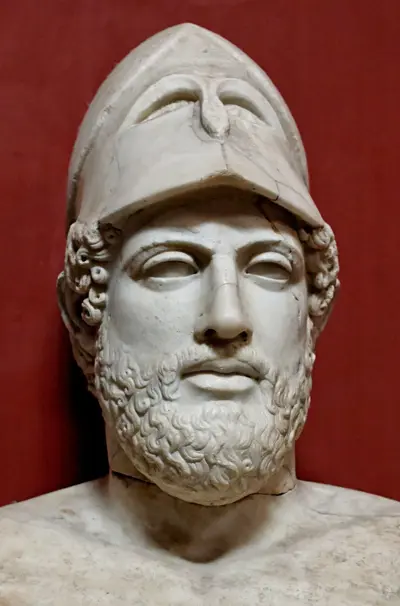
Pericles (/ˈpɛrɪkliːz/; Attic Greek: Περικλῆς, pronounced [pe.ri.klɛ̂ːs] in Classical Attic; c. 495 – 429 BC) was a Greek statesman and general of Athens during its golden age. Pericles was prominent and influential in Athenian politics, particularly between the Persian and the Peloponnesian Wars, and was acclaimed by Thucydides, a contemporary historian, as "the first citizen of Athens". He turned the Delian League into an Athenian empire and led his countrymen during the first two years of the Peloponnesian War. The period during which he led Athens, roughly from 461 to 429 BC, is sometimes known as the "Age of Pericles", but the period thus denoted can include times as early as the Persian Wars or as late as the following century.
