Ron Paul Quotes
Our federal government, which was intended to operate as a very limited constitutional republic, has instead become a virtually socialist leviathan that redistributes trillions of dollars. We can hardly be surprised when countless special interests fight for the money. The only true solution to the campaign money problem is a return to a proper constitutional government that does not control the economy. Big government and big campaign money go hand-in-hand.
Paul, Ron. "Campaign Finance Reform: The Real Threat to Liberty." Texas Straight Talk, US House of Representatives, 16 Jul. 2001.

His unusual theory was that if government could or did not do much to affect the economy, there would be no reason for a large corporation to invest money in electing a particular party or candidate. Therefore the way to get the influence of big money out of politics is to reduce the role of government drastically. Paul was one of the very few Conservative politicians who would publicly state that the reasons that corporations made campaign contributions was to buy political favors, favorable legislation or tax treatment. If corporate investments did not pay off for the company, shareholders would not tolerate spending investment money for a particular political philosophy as most companies have shareholders representing the range of American political opinion and their investments should pay off to the bottom line—profits.


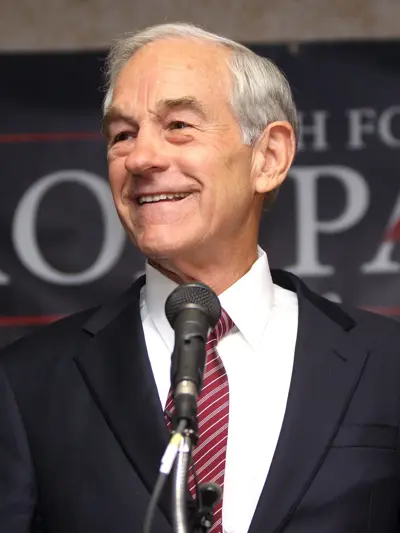
Ronald Ernest Paul is an American author, physician, and retired politician who served as the U.S. Representative for Texas's 22nd congressional district from 1976 to 1977 and again from 1979 to 1985, and for Texas's 14th congressional district from 1997 to 2013. On three occasions, he sought the presidency of the United States: as the Libertarian Party nominee in 1988 and as a candidate for the Republican Party in 2008 and 2012. A self-described constitutionalist, Paul is a critic of the federal government's fiscal policies, especially the existence of the Federal Reserve and the tax policy, as well as the military–industrial complex, the war on drugs, and the war on terror. He has also been a vocal critic of mass surveillance policies such as the USA PATRIOT Act and the NSA surveillance programs. He was the first chairman of the conservative PAC Citizens for a Sound Economy, a free-market group focused on limited government, and has been characterized as the "intellectual godfather" of the Tea Party movement, a fiscally conservative political movement that is largely against most matters of interventionism.
