Jurgen Habermas Quotes
Osama bin Laden, the person, more likely serves the function of a stand-in. Compare the new terrorists with partisans or conventional terrorists in Israel. These people often fight in a decentralized manner in small, autonomous units, too.
Habermas, Jürgen. "Fundamentalism and Terror." Philosophy in a Time of Terror: Dialogues with Jürgen Habermas and Jacques Derrida, by Giovanna Borradori, U of Chicago P, 2003, p. 34.


This quotation was used by many who opposed foreign aid to Egypt. At the time, Egypt was the second largest recipient of American foreign aid and yet there were leading Egyptians who held views like this. Advocates of aid to Egypt argued that it was in large part the American aid that was preventing radicals like Sabahi from controlling Egypt.
This quotation provides a succinct view of most non-Western Muslims on the issue of the definition of “terrorist.” A “mujahid” can be translated from Arabic as “freedom fighter.” To the rest of the world, terrorism is defined by the techniques and behavior of the doer. To many Muslims, it is defined only by the motive. If one is defending land or a cause, he cannot be a terrorist. The only terrorist to a Muslim holding this point of view is a person who engages in these violent methods for no reason. The essential difference is that to most of the world a cause—even a worthy one—does not justify any methodology or cost. To the Islamicist who accepts Al-Jozo’s point of view, there is NO methodology that is immoral, especially if one is fighting for a cause, and no cause is more worthy than the spread and dominance of Islam and the world of God. Therefore, for that cause, there can be no terrorism as there can be no ethical or moral limits.

36 days later, September 11, he did strike. See {617467} for some of the specific contents. The memo was kept secret by the Bush administration until public pressure as a result of the 9-11 Commission hearings forced the declassification and release. At that point it became clear that there was no reason that the memo could not have been released much earlier except that it was embarrassing. See {637530} and {637533} for two other Bin Laden Warnings that Bush and his team ignored.


36 days later, September 11, he did strike, and at the World Trade Center. The memo was kept secret by the Bush administration until public pressure as a result of the 9-11 Commission hearings forced the declassification and release. At that point it became clear that there was no reason that the memo could not have been released much earlier except that it was embarrassing.

Bush claimed he did not remember the conversation. His incoming National Security Advisor, Condoleezza Rice, was also briefed about bin Laden by the Clinton anti-terrorism director, Richard Clarke. The Bush Administration ignored the warnings until bin Laden struck on 9-11


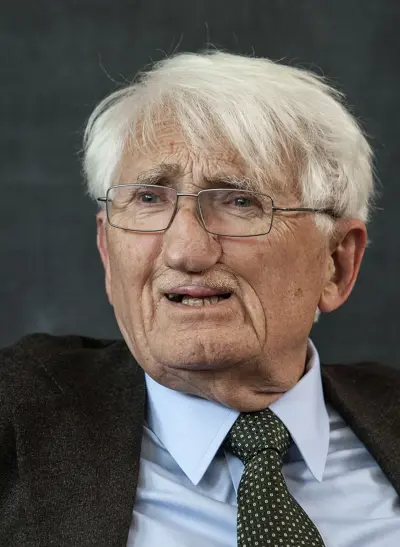
Jürgen Habermas is a German philosopher and sociologist in the tradition of critical theory and pragmatism. His work addresses communicative rationality and the public sphere.
