Jimmy Carter Quotes
One of the reasons that I did not win reelection, was that I was unable to hold the Democratic Party together.
Carter philosophically did not see his role as the head of his party anywhere near as important as his Presidential role. At the same time, Carter had forged Congressional majority support from a coalition of conservative Democrats and liberal Republicans. However, that alienated him even more from the liberal Democrats who even fielded Ted Kennedy as a primary candidate against him. Carter won the nomination but lost many of his own party for the general election and he lost to Ronald Reagan.
Jimmy Carter, 39th President of the United States (Democrat, GA), Interview, C-SPAN, November 29, 2010
Sourced by: Eigen's Political and Historical Quotations


Democratic Speaker of the Oklahoma House Jim Barker was so heavy-handed that his own party members combined to unseat him:

While all the traditional Democratic interest groups supported Mondale, the average voters were not so enthusiastic. The Democrats lost 49 states to Ronald Reagan. The interest groups in the base of each party can help increase the turnout for a candidate or sit on their hands and suppress it. But if the individual voters are not generally enthused for a candidate, the interest groups cannot deliver a win in a presidential election.


This passage from the Watergate tapes show how even after the Watergate scandal had started to unravel, Nixon and his staff were oblivious to what Nixon’s behavior had been and blamed critics for all the problems. It also shows the mindset that existed then in the White House that political opponents were enemies of the state and traitors. It was a throwback to monarchies were any opponent or critic of the King was by definition a traitor. This quotation is used by historians to not only show the Nixon paranoia about critics, but it shows the way Kissinger pandered to the President’s paranoia at the time. Whether Kissinger’s behavior was self-serving and hypocritical as his critics charge or a clever attempt to manage the President and Watergate crisis into a “soft landing” with Nixon’s resignation, as his supporters argue, it is hard to tell.


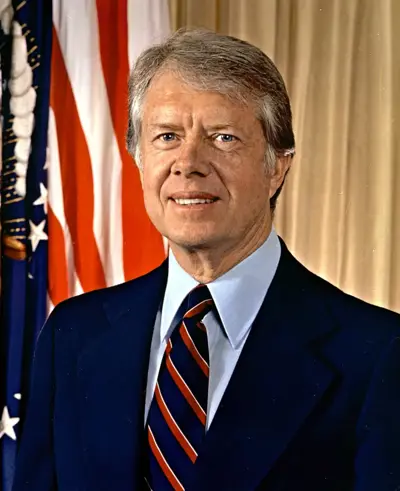
James Earl Carter Jr. is an American politician, businessman, and philanthropist who served as the 39th president of the United States from 1977 to 1981. A member of the Democratic Party, he previously served as a Georgia State Senator from 1963 to 1967 and as the 76th governor of Georgia from 1971 to 1975. Since leaving the presidency, Carter has remained engaged in political and social projects as a private citizen. In 2002, he was awarded the Nobel Peace Prize for his work in co-founding the Carter Center.
