New York Times Quotes
One of the most remarkable occurrences of the army has this moment taken place. Park Spring, the telegraph operator, situated in Prof. Lowe’s balloon, at an elevation of one thousand feet….is freely and rapidly communicating with the Department at Washington. This is certainly an ingenious and valuable method of giving instantaneous information.
The Professor just connected a telegraph wire to the balloon tether rope and the observer/telegraph operator in the balloon could describe in real time the position, deployment, weapons and strength of the Confederates. The information was picked up by the Union officers on the ground and a few seconds later by Washington where Abraham Lincoln, a brilliant innovator in the use of telegraph technology, had a telegraph office right next to the White House. Observational intelligence was in real time reaching the Commander in Chief and the war planners not unlike the functionality of a modern observational drone. The graphic is a photo of that balloon preparing for launch.
New York Times, Dispatch Near the Chickahominy, June 5, 1862
Sourced by: Eigen's Political and Historical Quotations

Lincoln used the very “estimate” to mean value or hold in esteem, a meaning which is no longer in use.
This seemingly prosaic quotation is one of the most significant quotations in history. At the outbreak of the Civil War, the telegraph was rapidly developing as a communications technology. One of Lincoln’s greatest achievements was the appreciation of the new technology and the deployment of it to gain an immense strategic advantage which was a major factor in all warfare thereafter. Lincoln placed ALL telegraphy of the North under the control of the military. He then had a telegraph terminal installed in the War Department right next to the White House. He would spend many hours in the Telegraph Room reading dispatches as they were coming in. To the distress of some of his military commanders, the Commander in Chief actually, for the first time in history, received virtually real time intelligence about a battle, and issued orders to the commanders in the field in real time. The quotation is one of the early examples. Ironically, Lincoln had more real time battlefields information in the Civil War than most of our Presidents did until the Vietnam War when digital, radio communications were exploited for the purpose.


This is always a problem in parts of the world where conflicts operate with many different parties and theater are personal grudges and scores to settle.
Southern intellectuals at the beginning of the Civil War were convinced of their invincibility. They misjudged both the effect of the industrial and technological might and the moral intensity of the North.

Mead argues that this is a trend that has been operating over many administrations. It could be argued that modern communications and the media have been significant drivers of this phenomenon along with the desire for White House staff to have as much control as they can obtain. Before modern communications, an Ambassador, or a Secretary of Commerce had to make decisions within the philosophical and political umbrella of the President’s general policies. They could not communicate immediately with the President or his staff. But once everyone in the government was connected, the President’s staff could make every important decision. However, with the many different major issues and emergencies of the modern era, the small group in the What House have not been able to deal with them all and the bureaucracy has been instructed not to decide big things without going through the White House. See {642086}.

The AUMF was passed 3 days after the terrorist attack on the World Trade Center and the Pentagon on September 11, 2001.

The “surge” was the short term injection of a large number of American combat troops into Iraq when the Iraq War was going badly. President George W. Bush, who at the urging of Vice President Cheney and the neoconservatives had invaded Iraq and while the invasion went well the administration botched the so-called peace and America was in the midst of a Iraqi civil war. Bush went ahead with the surge despite the advice of the Joint Chiefs. What makes the quotation particularly interesting, beyond the fact that the senior military advice was ignored, was that the President had always campaigned on the principle that the President should listen to the senior American Military officials on military tactics and strategy. He like Franklin Roosevelt, Harry Truman, Dwight Eisenhower, John F. Kennedy, and other presidents found that the military leadership perspective was often very narrow and not even militarily infallible. The Iraq War turned in our favor after the surge albeit that there have been arguments since then as to whether or not the surge was the reason or was it due to other factors which occurred at the same time. Probably, all were factors.
The things that makes this quotation historically important is how fast Cixi was adopting modern technology as a tool to manage the government and how she was managing day to day the significant international negotiations taking place on the other side of the earth. While in most areas Chinese bureaucracy was notorious for obstructionism and delay, Cixi maintained direct and almost real time control of the parts of the government that she felt most important. She resembled Abraham Lincoln in the sense that they both found innovative ways to use new technology to enable them to better and more directly manage and control the government.


He was one of the first to realize that technology was shaping the relations of people and states throughout the world. In 1891 most other people did not appreciate this dynamic including most politicians. However, we might wonder today what period of time he was contemplating when he used the word “rapidly”. Some have concluded that the globalization resulting from technology has been astoundingly fast while others see it as far too slow and it has a long way to go. See the related quotes for others who were early observers of the coming changes. See the Relates Quotes for more of the early observations of this phenomenon.

George W. Bush and his White House Staff were of a generation that only thiought of a personal computer as a Word Processing and e-mailing machine. In the 8 years of the Bush Presidency, there were dramatic and dynamic breagthouhs on PCs and digital technology. But they percieved no need for anything more, The younger, much more technoplogically savy Obama and his staff were shocked that the headquarters of the most important leader in the world was so far behind the times in their digital capability, The White House Website that was being used was that developed in teh first Clinton Administration which then was the state of the art. But more than 15 years later, it was ancient and decrepid. The Obama Team leaped into the future with a very sophisticated new website whcih was the backbone of Obama's highly sophisticated digital communications strategy.


The improved access comes from the rapid technological and economic development of open source information available to the public. Governments will also benefit although governments will not be able to maintain as much secrecy,

George W. Bush and his White House Staff were of a generation that only thiought of a personal computer as a Word Processing and e-mailing machine. In the 8 years of the Bush Presidency, there were dramatic and dynamic breagthouhs on PCs and digital technology. But they percieved no need for anything more, The younger, much more technoplogically savy Obama and his staff were shocked that the headquarters of the most important leader in the world was so far behind the times in their digital capability, The White House Website that was being used was that developed in teh first Clinton Administration which then was the state of the art. But more than 15 years later, it was ancient and decrepid. The Obama Team leaped into the future with a very sophisticated new website whcih was the backbone of Obama's highly sophisticated digital communications strategy.

See {635101} for a much ealier view of war’s uncertainty.
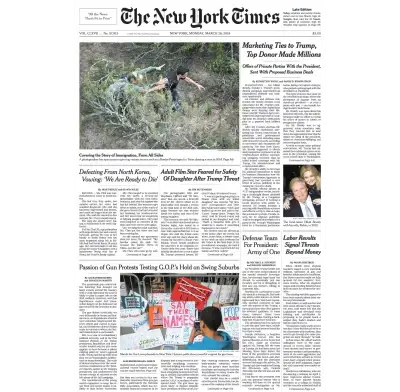
The New York Times (NYT or NY Times) is an American daily newspaper based in New York City with a worldwide readership. Founded in 1851, the Times has since won 130 Pulitzer Prizes (the most of any newspaper), and has long been regarded within the industry as a national "newspaper of record". It is ranked 18th in the world by circulation and 3rd in the U.S.
