Noam Chomsky Quotes
One can contrive a religious motivation for virtually any choice of action, from commitment to the highest ideals to support for the most horrendous atrocities. In the sacred texts, we can find uplifting calls for peace, justice and mercy, along with the most genocidal passages in the literary canon. Conscience is our guide, whatever trappings we might choose to clothe it in.
Chomsky, Noam, and David Barsamian. What We Say Goes: Conversations on U.S. Power in a Changing World. Metropolitan Books, 2007.

The Abenaki Indians from Canada had come South and raided many of the settlements of upstate New York. In the process, they committed many atrocities killing civilian men, women and children. Amhurst ordered Robert Rogers and his rangers to attack the Abenaki home villiage in Canada on a famous punitive raid. The Rangers, did indeed, raid the Abenaki and wiped out all the males of the tribe that were in the camp at the time. Amhurst hated Indians, but still had his standards regarding the killing of women and children, but was perfectly willing to kill all the mature males. There were no Geneva Conventions at the time. The same general introduced biological warfare by giving Indians smallpox infected blankets. See {619646}

Although nether he or the Sultan had made vigorous efforts to stop the massacres, he had promised the world community that Turkey would see that justice was done (See {620596} ). However, there were a few tried and one governor of a province was hanged and a few others received short jail sentences. Talaat, the worst of The Young Turks regarding the genocide, escaped to Germany. But he was tracked by a surviving Armenian who assassinated Talaat. The assassin was acquitted by a sympathetic German court which ruled that the extermination of the assassin’s family had been so traumatic that temporary insanity relieved the assassin of criminal responsibility.


What is particularly interesting about this quotation is that the author was not a religious leader or a philosopher, but a hard-nosed military man and ruler. He recognized the corrosive effect on a society that a thirst for revenge can bring.

The allies—mostly under American Pressure—only tried the highest ranking Nazi war criminals. Many wanted to try the rest, but they did not prevail. Lord Russell, the English prosecutor at Nuremburg resigned in protest as he had case files on over 100,000 Nazi war criminals who were never prosecuted. The main object was to use those officials to establish a strong anti-Communist government in post war Germany.
Mehmet Talaat Pasha was one of the national leaders who adopted the policy of extermination of the Armenians. The Christian Armenians, a minority in Turkey and its lands, were discriminated against like other non-Muslim minorities in the Ottoman Empire. But during the Turkish War with Russia, some Armenians defected and served on the Russian side. Many Turkish citizens took revenge on Armenians by means of murder and torture. Soon, the extermination of the Armenians became the official “Young Turk” government policy.


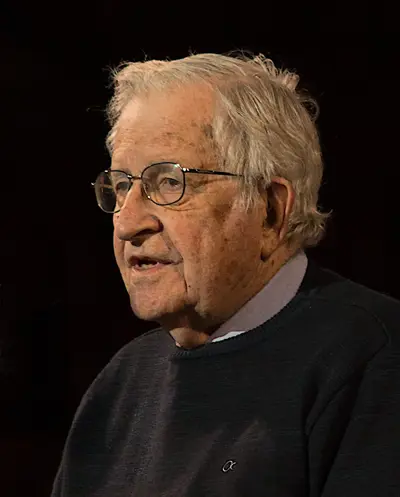
Avram Noam Chomsky is an American linguist, philosopher, cognitive scientist, historian, social critic, and political activist. Sometimes called "the father of modern linguistics", Chomsky is also a major figure in analytic philosophy and one of the founders of the field of cognitive science. He is Laureate Professor of Linguistics at the University of Arizona and Institute Professor Emeritus at the Massachusetts Institute of Technology (MIT), and is the author of more than 150 books on topics such as linguistics, war, politics, and mass media. Ideologically, he aligns with anarcho-syndicalism and libertarian socialism.
