Karl Marx Quotes
Once the inner connection is grasped, all theoretical belief in the permanent necessity of existing conditions collapses before their collapse in practice -- Letter to Ludwig Kugelmann (July 11, 1868)
Marx, Karl. "Marx to Ludwig Kugelmann. 11 July 1868." Marx & Engels Collected Works, Vol. 43, International Publishers, 1988, p. 68.


Vladimir Lenin. Even plant and animal evolution does not progress slowly and steadily.


Derogatory description of John F. Kennedy.

Lev Davidovich Bronstein. Although Plekhanov was the intellectual giant of Russian communism, he died only two years into the revolution. He was never happy with some of the pragmatic compromises the younger firebrand communist leaders were making from their ideals. By the time he passed away, most, especially the younger, communist leaders like Stalin saw him as an old obstructionist and he was never celebrated as a hero by the communists. It was Trotsky and older leaders like Lenin who appreciated him. See {590463}.


Since the end of WWII till the breakup of the Soviet Union, the Bulgarians were part of the Soviet Bloc and operated under communism that was supposedly based on Marxism. However it was not in many critical respects. But few modern Russian style Communists are familiar with or understand Marxism.
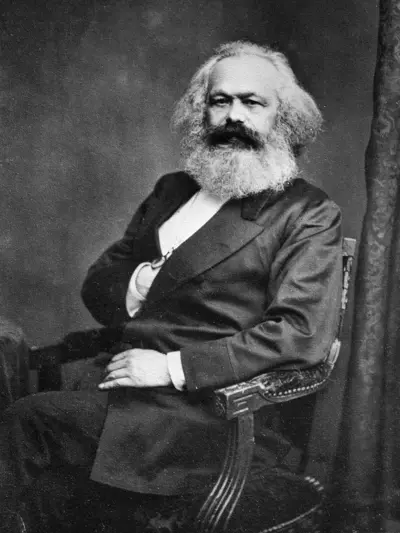
Karl Heinrich Marx was a German philosopher, economist, historian, sociologist, political theorist, journalist and socialist revolutionary. Born in Trier, Germany, Marx studied law and philosophy at university. He married Jenny von Westphalen in 1843. Due to his political publications, Marx became stateless and lived in exile with his wife and children in London for decades, where he continued to develop his thought in collaboration with German thinker Friedrich Engels and publish his writings, researching in the reading room of the British Museum. His best-known titles are the 1848 pamphlet The Communist Manifesto and the three-volume Das Kapital (1867–1883). Marx's political and philosophical thought had enormous influence on subsequent intellectual, economic and political history. His name has been used as an adjective, a noun, and a school of social theory.
