H. G. Wells Quotes
Once the command of the air is obtained by one of the contending armies, the war becomes a conflict between a seeing host and one that is blind.
Wells, H. G. Anticipations. Chapman & Hall, 1901.


This quotation has significance for two reasons. First, Lodge was one of the leaders of the conservative isolationist wing of the Republican Party which generally only wanted to provide the military with weapons to defend the mainland. However, the technology of the airplane caused much rethinking. Americans had seen what German bombing had done to Spanish cities and Italian air power in Ethiopia. This followed by Germany bombing city after city throughout Europe. There were huge calls for antiaircraft guns to be placed around all American cities so that Americans might be defended from air attack. However, Lodge supported another strategy that was a first for America: retaliation. From this point forward, America would rely primarily on retaliation rather than massive defense until President Ronald Reagan proposed his ill-fated Star Wars defense scheme. The second significant factor is that the senator suggested preemption—the attack on a military air base is that threatens us. This appears to be another first.

There were few military thinkers at that time who would agree with Goebbels on this point.

At the time, most Japanese (and American and worldwide) Naval leaders and strategists believed that it was the battleship that was the critical naval weapon. Yamamoto proved to be correct and ironically, the American Aircraft Carriers and Planes were his undoing.

This appears to be the first public call for Anti-Ballistic Missile Weapons & Systems. To many it is surprising that in 1946, there would be concern about missile defense, however during WWII, the Germans, violating the laws of war, struck London and other English cities with V2 rocket—the first ballistic missiles. England had suffered many civilian casualties and missile defense was a high priority for them.

The Seals who conducted the raid captured all the computers and documents that there were in bin Laden’s compound.


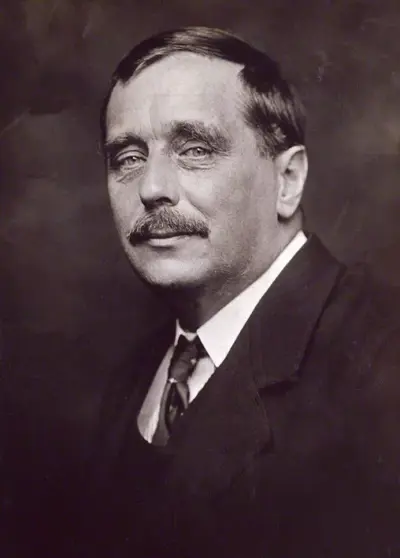
Herbert George Wells —known as H. G. Wells—was a prolific English writer in many genres, including the novel, history, politics, social commentary, and textbooks and rules for war games. Wells is now best remembered for his science fiction novels and is called a "father of science fiction", along with Jules Verne and Hugo Gernsback.[a] His most notable science fiction works include The Time Machine (1895), The Island of Doctor Moreau (1896), The Invisible Man (1897), and The War of the Worlds (1898). He was nominated for the Nobel Prize in Literature four times.
