Peter Singer Quotes
Of course, infanticide needs to be strictly legally controlled and rare - but it should not be ruled out, any more than abortion.
Singer, Peter. "Killing Babies Isn't Always Wrong." The Spectator, 16 Sept. 1995, p. 20.

One of the extreme religious fundamentalists in the Congress, Brownback was referring to Federally funded medical research which uses embryonic stem cells. The cells are generated from in vitro fertilization procedures and potentially if implanted in the womb of a woman could produce a child. Several cells are produced by the fertilization process but typically only one or two is needed. So some religious extremists believe that just because the cell has the potential for human life, it is human life. This is the same logic which opposes birth control on the grounds that sperm and egg cells are incipient life forms. It was as late as 1973 that bans on birth control devices were declared unconstitutional be the Supreme Court.


Reacting to the public and media outrage at Oliver North shredding documents in the Iran-contra scandal:

Barnabus, like most Christians at the time, was also Jewish and was reflecting the Jewish view on abortion and infanticide in that part of the world. However, the Christians tended to be more forgiving than traditional Judaism was and made much greater provision for repentance and forgiveness. See {620149} .

This was the traditional Jewish view of abortion and infanticide. It is the view of the Orthodox Jews of today, but the larger body of Reform Jews, like many Protestant sects, do not equate abortion to murder or infanticide.

In most parts of the country, if the legislators did not carve out the exceptions for rape incest and danger to the life of the mother, they would lose the majority of their support as most Americans who oppose the freedom of abortion that existed after Roe v. Wade, but really do not view abortion in the early trimester as murder. They just think that the regulation should be greater than it is.


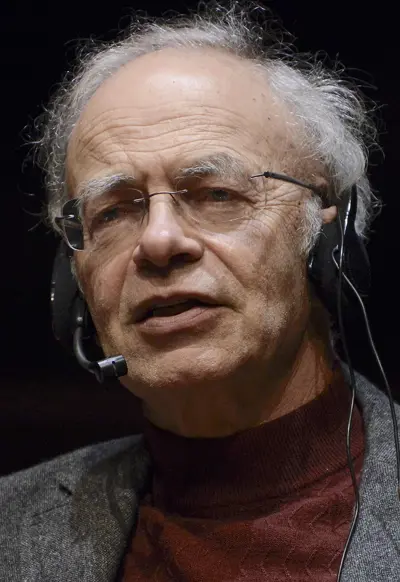
Peter Albert David Singer AC is an Australian moral philosopher, currently the Ira W. DeCamp Professor of Bioethics at Princeton University. He specialises in applied ethics and approaches ethical issues from a secular, utilitarian perspective. He is known in particular for his book Animal Liberation (1975), in which he argues in favour of veganism, and his essay "Famine, Affluence, and Morality", in which he argues in favour of donating to help the global poor. For most of his career, he was a preference utilitarian, but he stated in The Point of View of the Universe (2014), coauthored with Katarzyna de Lazari-Radek, that he had become a hedonistic utilitarian.
