Peter Singer Quotes
Of all the arguments against voluntary euthanasia, the most influential is the 'slippery slope': once we allow doctors to kill patients, we will not be able to limit the killing to those who want to die.
Singer, Peter. Practical Ethics. Cambridge University Press, 1979, p. 149.


In the next two years 50,000 non-Jewish, ill Germans were killed in hospital gas chambers disguised as shower rooms as the Germans later did with the Jews in the concentration camps.

The “logic” of the Japanese was that by eliminating “troublemakers” (those objecting to the Japanese invasion) the lives of other Chinese were saved. This extended to rape and murder of women, beheading of boys and men—civilians and military—and destruction of infants.

Sarah Palin, former Republican Governor of Alaska, coined a new term when she charged that proposed Health Care legislation would create a "death panel" See Palin Quotation 644138. It was an absolute lie totally made up by Palin. However a number of conservative members of Congress then repeated the prevarication in Congressional Debate and elsewhere. One poll showed that after it spread, about 85% of respondents were familiar with the charge and of those who were familiar with it, about 30% thought it was true and Palin's new term won the dubius distinction of winning the "Lie of the Year" award. Despite the fact that it was totally false, in order to win Obamacare be a single vote, the President had to eliminate the part of the bill that allowed payment to physicians to take the time and explain to patients and/or their families, the various options of palliative treatment during the last months of life. Many people thought that the doctors would form death panels.


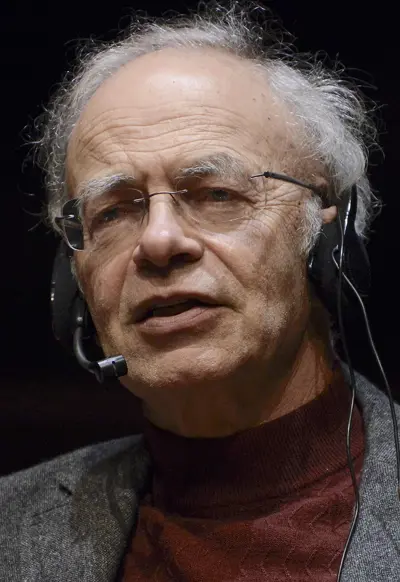
Peter Albert David Singer AC is an Australian moral philosopher, currently the Ira W. DeCamp Professor of Bioethics at Princeton University. He specialises in applied ethics and approaches ethical issues from a secular, utilitarian perspective. He is known in particular for his book Animal Liberation (1975), in which he argues in favour of veganism, and his essay "Famine, Affluence, and Morality", in which he argues in favour of donating to help the global poor. For most of his career, he was a preference utilitarian, but he stated in The Point of View of the Universe (2014), coauthored with Katarzyna de Lazari-Radek, that he had become a hedonistic utilitarian.
