Aristotle Quotes
Now the greatest external good we should assume to be the thing which we offer as a tribute to the gods, and which is most coveted by men of high station, and is the prize awarded for the noblest deeds; and such a thing is honor, for honor is clearly the greatest of external goods.
Aristotle. The Nicomachean Ethics of Aristotle. Translated by J. E. C. Welldon, Macmillan and Co., 1892, p. 110.


Shammai’s school was a contemporary (and competitor) of that of Hillel. Most Rabbinic thought to this day has historically been based in the school of Hillel. Shammai was more strict and rigorous. There is no known surviving picture of Shammai. The graphic is a photograph of his tomb.


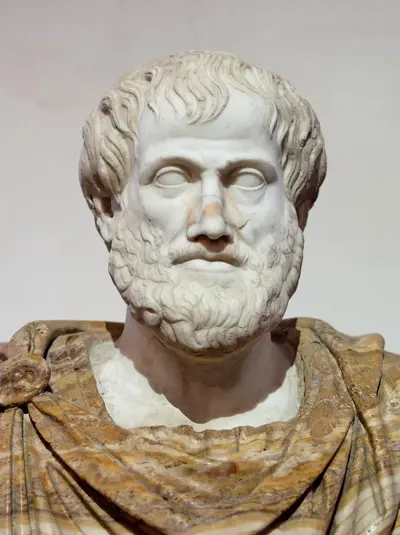
Aristotle (/ærɪˈstɒtəl/; Greek: Ἀριστοτέλης Aristotélēs, pronounced [aristotélɛːs]; 384–322 BC) was a Greek philosopher and polymath during the Classical period in Ancient Greece. Taught by Plato, he was the founder of the Lyceum, the Peripatetic school of philosophy, and the Aristotelian tradition. His writings cover many subjects including physics, biology, zoology, metaphysics, logic, ethics, aesthetics, poetry, theatre, music, rhetoric, psychology, linguistics, economics, politics, meteorology, geology and government. Aristotle provided a complex synthesis of the various philosophies existing prior to him. It was above all from his teachings that the West inherited its intellectual lexicon, as well as problems and methods of inquiry. As a result, his philosophy has exerted a unique influence on almost every form of knowledge in the West and it continues to be a subject of contemporary philosophical discussion.
