Sophocles Quotes
No yield to the dead! Never stab the fighter when he's down. Where's the glory, killing the dead twice over?
Sophocles. The Three Theban Plays. Translated by Robert Fagles, Penguin Classics, 1982, p. 109, lines 1029-1030.


This is the modern view of the old Chinese adage with a modern democratic motivation.


For "widow and orphan," see Exodus 22:22; Deuteronomy 10:18, ‘To care for him who shall have borne the battle, and for his widow and orphan’ is inscribed on a plaque in the Veterans Administration headquarters. See John Quincy Adams for an earlier coupling of “malice” and “charity.” There is no evidence that Lincoln had ever seen the Adams letter.”


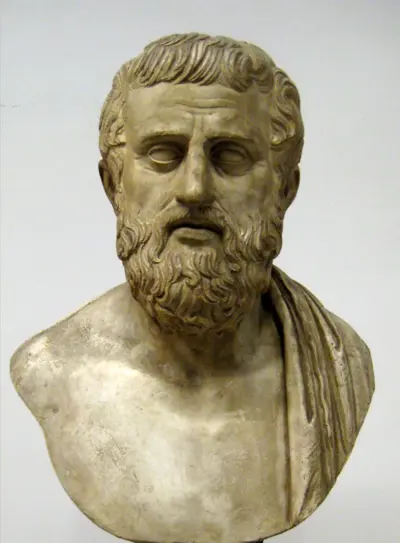
Sophocles (/ˈsɒfəkliːz/; Greek: Σοφοκλῆς, pronounced [so.pʰo.klɛ̂ːs]; c. 497/6 – winter 406/5 BC) is one of three ancient Greek tragedians whose plays have survived. His first plays were written later than, or contemporary with, those of Aeschylus; and earlier than, or contemporary with, those of Euripides. Sophocles wrote over 120 plays, but only seven have survived in a complete form: Ajax, Antigone, Women of Trachis, Oedipus Rex, Electra, Philoctetes and Oedipus at Colonus. For almost fifty years, Sophocles was the most celebrated playwright in the dramatic competitions of the city-state of Athens which took place during the religious festivals of the Lenaea and the Dionysia. He competed in thirty competitions, won twenty-four, and was never judged lower than second place. Aeschylus won thirteen competitions, and was sometimes defeated by Sophocles; Euripides won four.
