Homer Quotes
My hour at last has come;
Yet not ingloriously or passively
I die, but first will do some valiant deed,
Of which mankind shall hear in after time.
Homer. The Iliad of Homer. Translated by William Cullen Bryant, vol. 2, Fields, Osgood, & Co., 1870, p. 288.


The USS Philadelphia was a 1240-ton, 36-gun sailing frigate of the United States Navy which was sent to Tripoli in the First Barbary War. On October 31, 1803, she ran aground on an uncharted reef off Tripoli Harbor. Under fire from shore batteries and Tripolitan gunboats, Captain Bambridge had to surrender the crew and the ship, which was a far better vessel than any which the Barbary Pirates sailed. President Jefferson and the naval authorities believed that the Philadelphia should not be allowed to be repaired and serve Tripoli. Under the guise of a ship in distress in need of a place to tie up after having lost all anchors in a storm, on February 16, 1804 a volunteer assaulting party of officers and men under Lieutenant Stephen Decatur, Jr. boarded her from the ketch Intrepid and after making sure that she was not seaworthy burned her where she lay in Tripoli Harbor amidst the Tripolitan naval fleet, returned the Intrepid and escaped denying the enemy the use of a modern warship.


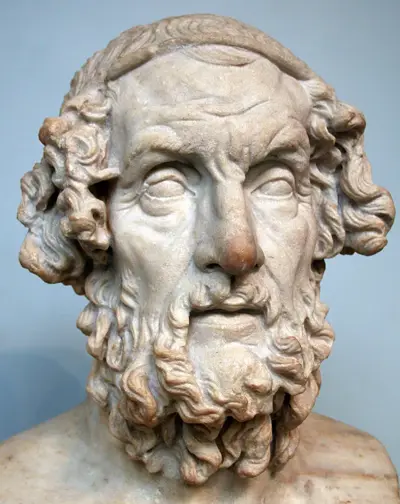
Homer (/ˈhoʊmər/; Ancient Greek: Ὅμηρος [hómɛːros], Hómēros) was the presumed author of the Iliad and the Odyssey, two epic poems that are the foundational works of ancient Greek literature. The Iliad is set during the Trojan War, the ten-year siege of the city of Troy by a coalition of Greek kingdoms. It focuses on a quarrel between King Agamemnon and the warrior Achilles lasting a few weeks during the last year of the war. The Odyssey focuses on the ten-year journey home of Odysseus, king of Ithaca, after the fall of Troy. Many accounts of Homer's life circulated in classical antiquity, the most widespread being that he was a blind bard from Ionia, a region of central coastal Anatolia in present-day Turkey. Modern scholars consider these accounts legendary.
