Stephen Douglas Quotes
Mr. Lincoln has not character enough for integrity and truth.
This was the first of the famous Lincoln-Douglas Debates. The men were contesting for the U. S. Senate. Douglas won the election.
Stephen Douglas, 1813-1861, U. S. Congressman & U. S. Senator (Democrat, IL), First Debate with Abraham Lincoln, Ottawa, Illinois, August 21, 1858
Sourced by: Eigen's Political and Historical Quotations

This was the first of the famous Lincoln-Douglas Debates. The men were contesting for the U. S. Senate. Douglas won the election. Note that competing politicians were misrepresenting each other then as now. Note that Lincoln the more gross the attack and misrepresentation, the more Lincoln thought the effort funny. He had a very thick skin. For a gross example, see {627129}.


See {640733} for an English political leader’s similar view.

The Senator received some bad press regarding his part in the railroad rate reform issue. He believed that the stories were planted by his political enemies.

Samuel Langhorne Clemens, 1835-1910. From the point of view of the person or company that bribes or gives campaign contributions to legislators, there has often been a problem that when the heat is on the legislator might begin to refrain from voting as was expected. Twain was joking in this quotation by using the world “morality” to describe the obligation of the legislator to vote for the interest of the briber or campaign contributor. However, there were several major businessmen who actually saw the bribed legislator as having a moral and ethical duty to continue to protect the interest of the briber.


This vague criterion was in effect and was initially used to clear scientists at Los Alamos and their spouses who were part of the team that was to develop the Atomic Bomb. The Army security people however had never been in such a situation before. Few distinguished scientists wanted to come to Los Alamos to begin with as once there, they were there for the duration of the war and were cut off from friends and relatives. But there were very few people in the entire country who had the unique education and training. When the security people rejected a candidate before that time, another person was recruited. But for many of the scientists at Los Alamos, they were one of a kind. There were not two Enrico Femi’s or Luis Alverez’s. “Moral fiber” could mean anything and the American academic world has always tolerated a wider variety of behavior then most of the rest of society. Sexual activity, left wing views, parental irresponsibility, failure to pay debts, attacking religion or religious organizations all created problems. But the biggest problem was association with others of “demonstrated weakness in moral fiber” including communists and left wingers. In most university settings, with a norm or tolerance, almost all associated with “undesirables”. As a result many scientists or family members could not get cleared. But the project could not function without them, and if some were fired for that reason, many others might have quit. Finally, General Groves, relaxed the standards, yet the army security officers were constantly suspicious. This criterion was in use as late as the 1960s where a brilliant scientist working in the Executive Office of the President was threatened with dismissal for this reason. She had borne an illegitimate child years earlier.


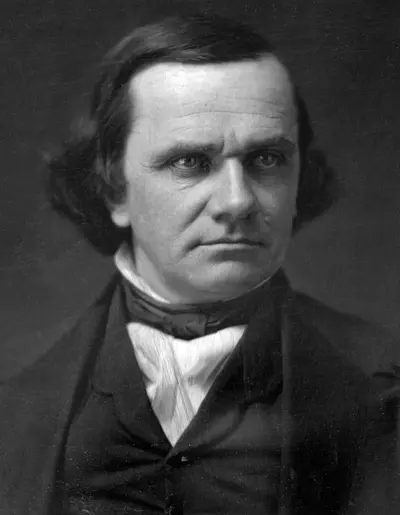
- Born: April 23, 1813
- Died: June 3, 1861
- Nationality: American
- Profession: Politician
Stephen Arnold Douglas was an American politician and lawyer from Illinois. He was one of two Democratic Party nominees for president in the 1860 presidential election, which was won by Republican Abraham Lincoln. Douglas had previously defeated Lincoln in the 1858 United States Senate election in Illinois, known for the Lincoln–Douglas debates. During the 1850s, Douglas was one of the foremost advocates of popular sovereignty, which held that each territory should be allowed to determine whether to permit slavery within its borders. Douglas was nicknamed the "Little Giant" and "Stevie D" because he was short in physical stature but a forceful and dominant figure in politics.
