Ruth Bader Ginsburg Quotes
Most states in the union where the death penalty is theoretically on the books don't have executions.
Ginsburg, Ruth Bader. My Own Words. Simon & Schuster, 2016.


Rosemary Barkett, Chief Justice of the Florida Supreme Court, was nominated to the U. S. Court of Appeals. In her previous role she had upheld over 200 death sentences. Nonetheless, Senator Hatch, an advocate of capital punishment, held up her swift confirmation.


One of the first actions after the revolution was to abolish the capital punishment used so arbitrarily by the Czars. It was even abolished for the army. Later, when more control over the population was needed, it was reinstated.


He referred to the Biblical injunction for capital punishment which mandated the death penalty for murder. However the Bible also requires the death penalty for adultery, heresy, blasphemy, homosexuality, and a number of other offenses including a son being disobedient to his father where death was also proscribed. This quotation is an excellent example of a rhetorical political technique where the speaker selectively provides the truth. Taken at its face, this argument would persuade many people, few of whom would still support the argument if they knew that it applied equally to a host of other behaviors many of which are not even regarded as crimes in a modern civilized society.


Louis Eugene Walcott. Malcolm X had criticized Elijah Mohammed for sexual behavior with staff.
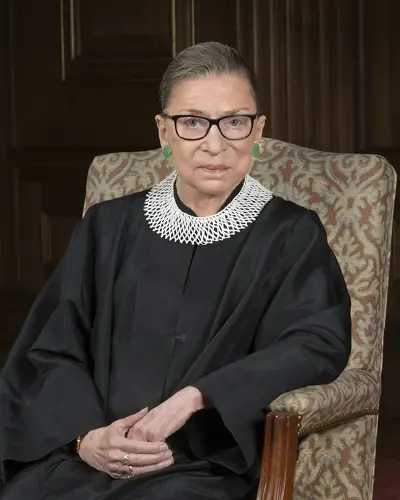
Joan Ruth Bader Ginsburg was an American lawyer and jurist who served as an associate justice of the Supreme Court of the United States from 1993 until her death in September 2020. She was nominated by President Bill Clinton, replacing retiring justice Byron White, and at the time was generally viewed as a moderate consensus-builder. She eventually became part of the liberal wing of the Court as the Court shifted to the right over time. Ginsburg was the first Jewish woman and the second woman to serve on the Court, after Sandra Day O'Connor. During her tenure, Ginsburg wrote notable majority opinions, including United States v. Virginia (1996), Olmstead v. L.C. (1999), Friends of the Earth, Inc. v. Laidlaw Environmental Services, Inc. (2000), and City of Sherrill v. Oneida Indian Nation of New York (2005).
