William McKinley Quotes
Most of our financial laws are the outgrowth of experience and trial, and should not be amended without investigation and demonstration of the wisdom of the proposed changes. We must both be sure we are right and make haste slowly.
Many people have criticized our citation of this McKinley quotation. They observe that the quotation comes from McKinley’s Inaugural Address given in Washington DC on March 3. They are correct about the Inaugural address observation, but what they do not realize is that the President tried out this language two days before. As he left Canton Ohio, he made a short speech trying out this line before a small crowd with almost no press coverage. Satisfied with the reaction, he used it again in the Inaugural Address two days later. Our citation policy generally cites the first time the quotation was used, and that is on March 1 in Canton, Ohio.
William McKinley, 1843-1901, 25th President of the United States (Republican, OH), Speech, Canton, Ohio, March 1, 1897
Sourced by: Eigen's Political and Historical Quotations


the largest economic and banking reform in decades The Dodd-Frank reform legislation was very complicated. It was extensively debated including attacks against provisions that were not even in the bill (See {632833}.) Few of the supporters and fewer of the opponents understood the bill. Many members on both sides had not even read the entire bill. It passed.

He was referring to Fannie Mae, the government-created. private mortage guarantee company. It was heavily regulated, and in general it met the regulatory requirements. However, the requirements were insufficient, and in the 2008 Meltdown and the Great Recession that followed, Fannie Mae itself was in such bad financial condition, that the Federal Government had bail them out or have the entire home mortgage industry fall apart.


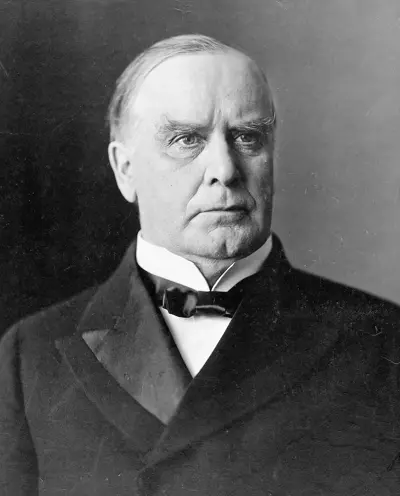
William McKinley was the 25th president of the United States, serving from 1897 until his assassination in 1901. McKinley was president during the Spanish–American War of 1898, raised protective tariffs to boost American industry, and rejected the expansionary monetary policy of free silver, keeping the nation on the gold standard.
