Sallust Quotes
Most honorable are services rendered to the State; even if they do not go beyond words, they are not to be despised.
Sallust. The Conspiracy of Catiline. Translated by J. C. Rolfe, Loeb Classical Library, Harvard University Press, 1921, p. 5.


This may be Kennedy’s most famous line. However he was not the first orator to express this idea however. See Khalil Gibran {601423}, Warren G. Harding {622594} and {629021}, St. John Broderick {595734}, and Oliver Wendell Holmes Jr. {603707} for earlier expressions of similar sentiments. Holmes seems to be the first to express the idea while the earliest seems similar phraseology seems to be the British Politician St. John Broderick in 1893 {595734}. Although, these earlier expressions existed, Theodore C. Sorensen, who assisted Kennedy with this speech and wrote the draft, had distilled it from earlier expressions and views of JFK and said that these were Kennedy’s words. At the time, he stated that was unaware of the Gibran, Harding, Broderick and Holmes sentiments. Gibran had not yet even been translated into English. However it is not clear whether Kennedy himself had inadvertently recollected the phrase from any of the other quotations. (The question was never put to him.) The St. John Broderick quotation is a possible source. Kennedy was quite familiar with British political history, and his father and been U. S. Ambassador to Great Britain. Regardless, the quotation was as great for the place and timing—his inaugural—as it was for the phraseology which might have originated elsewhere.

The Society of Cincinnati was formed just after the Revolutionary War by officers of the army, to perpetuate friendships, to aid each other and the widows and orphans of members, and to honor their French allies and comrades:


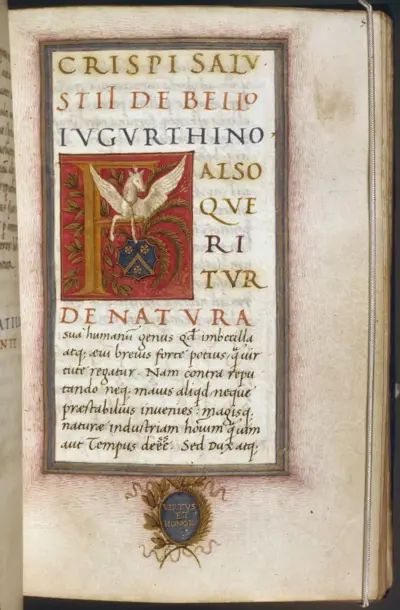
Gaius Sallustius Crispus, usually anglicised as Sallust (/ˈsæləst/; 86 – c. 35 BC), was a Roman historian and politician from an Italian plebeian family. Sallust was born at Amiternum in the country of the Sabines and was a popularis, an opponent of the old Roman aristocracy, throughout his career, and later a partisan of Julius Caesar. Sallust is the earliest known Latin-language Roman historian with surviving works to his name, of which Catiline's War (about the conspiracy in 63 BC of L. Sergius Catilina), The Jugurthine War (about Rome's war against the Numidian King Jugurtha from 111 to 105 BC), and the Histories (of which only fragments survive) are still extant. Sallust was primarily influenced by the Greek historian Thucydides and amassed great (and ill-gotten) wealth from his governorship of Africa.
