Robert M. Gates Quotes
Most governments lie to each other. That's the way business gets done.
Gates, Robert M. Department of Defense Press Briefing. 30 Nov. 2010, The Pentagon, Arlington, VA.


Comment to President Teddy Roosevelt as while he, as US Secretary of State, dealt extensively with a deceitful Russia as they attempted to expand into Chinese Manchuria which eventually led to the Russo-Japanese war of 1904-1905.

The Prime Minister was visiting the United States and was staying at the White House. President Roosevelt had a spontaneous thought and wheeled himself into Churchill's room. The Prime Minister was stark naked, having just emerged from the bath. Roosevelt apologized but Churchill was unfazed and known for his nudity in his private quarters. He even used what might have been an awkward moment into an opportunity to make a political point.


“The word “monitoring” is a polite diplomatic word for “spying on”. She made this statement in July of 2014 when the Germans discovered that the United States was spying on their government and ejected key Americans from the country. Albright was explaining that this is extremely common and “normal” between allies. See {640830} for more on this subject.


President Wilson had gone to Paris for peace treaty negotiations. Ex-President Roosevelt was on his deathbed. But even then TR was his politically contentious self.


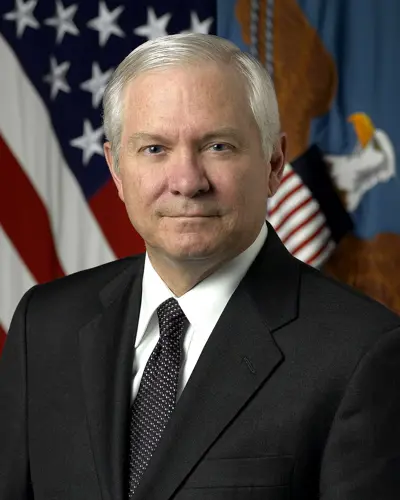
Robert Michael Gates is an American intelligence analyst, and university president who served as the 22nd United States secretary of defense from 2006 to 2011. He was originally appointed by President George W. Bush and was retained for service by President Barack Obama. Gates began his career serving as an officer in the United States Air Force but was quickly recruited by the Central Intelligence Agency (CIA). Gates served for 26 years in the CIA and the National Security Council, and was Director of Central Intelligence under President George H. W. Bush. After leaving the CIA, Gates became president of Texas A&M University and was a member of several corporate boards. Gates served as a member of the Iraq Study Group, the bipartisan commission co-chaired by James A. Baker III and Lee H. Hamilton, that studied the lessons of the Iraq War.
