Zbigniew Brzezinski Quotes
More directly linked to the impact of technology, it involves the gradual appearance of a more controlled and directed society. Such a society would be dominated by an elite whose claim to political power would rest on allegedly superior scientific know-how. Unhindered by the restraints of traditional liberal values, this elite would not hesitate to achieve its political ends by using the latest modern techniques for influencing public behavior and keeping society under close surveillance and control.
Brzezinski, Zbigniew. Between Two Ages: America's Role in the Technotronic Era. Viking Press, 1970, p. 252.


See Eigen {633625} for a more explicit personal statement of the choice for the individual.

He made this quotation in a discussion about nuclear weapons, but the principle is valid for many areas from the Internet to pharmaceuticals. In the nuclear weapons case there have been a number of accidents – including fatal ones – over the years and on several occasions a nuclear weapon came close to detonating near populated areas. In one case, radiation damage from a crash of a nuclear weapons equipped bomber have made an area in Spain unusable for years into the future.


Most scientists do not have the skill or the totality of knowledge to accurately predict the effect of scientific research and learning on society. Many are not interested. Those who try to communicate with politicians and the public are usually met with indifference or suspicion. Above all, the scientific and mathematical literacy of the public is so weak, that it is impossible in much of science to even explain the science to the lay public much less explain its implications. Soddy was a bit of an idealist from a class society and he felt the upper classes should be better informed by scientists.

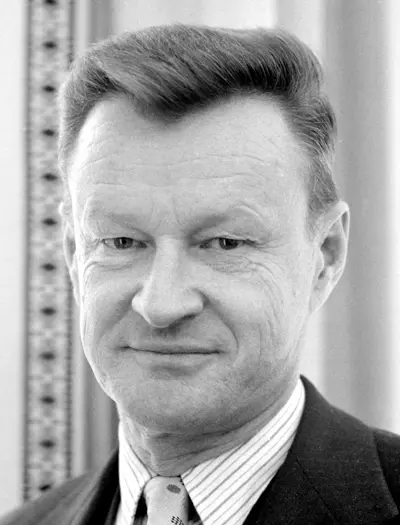
Zbigniew Kazimierz Brzezinski was a Polish-American diplomat and political scientist. He served as a counselor to President Lyndon B. Johnson from 1966 to 1968 and was President Jimmy Carter's National Security Advisor from 1977 to 1981. As a scholar, Brzezinski belonged to the realist school of international relations, standing in the geopolitical tradition of Halford Mackinder and Nicholas J. Spykman. Brzezinski was the primary organizer of The Trilateral Commission.
