Joan of Arc Quotes
Men are sometimes hanged for telling the truth.
Joan of Arc. The Trial of Joan of Arc. Translated by Daniel Hobbins, Harvard University Press, 2005, p. 60.


1st Baron Macaulay


In November of each year protesters gather at Fort Benning, the site of the U. S. Army School of the Americas. The School provides training for Latin American Military Officers in Counter-Insurgency Training. The graduates of the school have included some of the worst Latin American killers and torturers (See {41061} for example) who rose to positions of power in their lands. It has also included many leaders who did not ever resort to war crimes and atrocities and also became leaders of their countries. It has been an institution of great controversy since it was discovered that the school at one point taught methods of interrogating insurgents that were tantamount to torture. Defenders of the school claim that but for the school, the military atrocities would have been worse and that it contributed to more human and democratic governments in the Americas. The annual protest has attracted more than 16,000 protesters, some of whom—like Bourgeois—have been guilty of trespass and interfering with a government facility and have served jail terms for those violations.


Charles I had caused the death of his subjects with impunity and was called to account. However, the English Parliament did not know what specific crime the King had committed. Kings had executed people, guilty of crimes and otherwise, for centuries. For what could a king be accountable. Cooke developed the crime of Tyranny and drew up and presented the indictment for that. The King was found guilty and executed. This was the first time in legal history that a ruler was called to account for crimes committed against his own people. It became the foundation for many trials thereafter including that of Saddam Hussein in 2006.

Islam had been the center of intellectual thought in the world, until the clerics had decided that innovation itself was a sin and one that called for the death penalty. Although most non-Muslim religions went through stages of death for religious dissent. However, the Koran deals with every part of society. There is no separation of church and state. All knowledge is in the Koran the fundamentalist believes and anyone who expresses a new idea is not only wrong and a heretic, but is dangerous and must be executed. It is therefore not very surprising that the Islamic contributions to science, medicine, and the arts has been so small. The Islamic fundamentalists are opposed by Muslim modernists who try to change the Islamic culture but they are on the minority. Most religions have gone through bad earlier periods where dissent was heresy and warranted death. Fundamentalist Islam is the only one which bans original thought of any kinds even it does not contradict established doctrine.

Vladimir Lenin. One of the claimed benefits of Capital Punishment has always been the inhibition of others, but it turned out that it was never very effective at that. However, prevention was Lenin’s major objective so he ordered public hanging instead of shooting—the usual method of execution at the time. This infamous quotation started the new Russian government off on a horrible record of civil and human rights. The people hanged were not particularly guilty of any crime. They were just people who had gotten, or whose family was, rich under the Czar. The disregard for rule of law was most dramatically evidenced by this Lenin order. Needless to say, rich people the world over, saw a great threat to their lives from this new state wanting to export its philosophy.
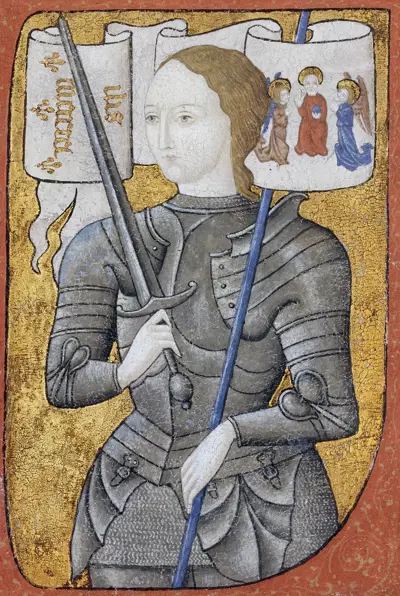
Joan of Arc, nicknamed "The Maid of Orléans" (French: La Pucelle d'Orléans) or "Maid of Lorraine" (French: La Pucelle de Lorraine), is considered a heroine of France for her role during the Lancastrian phase of the Hundred Years' War, and was canonized as a saint. She was born to Jacques d'Arc and Isabelle Romée, a peasant family, at Domrémy in the Vosges of northeast France. Joan said that she received visions of the archangel Michael, Saint Margaret, and Saint Catherine of Alexandria instructing her to support Charles VII and recover France from English domination late in the Hundred Years' War. The as-yet-unanointed King Charles VII sent Joan to the siege of Orléans as part of a relief army. She gained prominence after the siege was lifted only nine days later. Several additional swift victories led to Charles VII's consecration at Reims. This long-awaited event boosted French morale and paved the way for the final French victory at Castillon in 1453.
