Benjamin E. Mays Quotes
Many well-meaning intelligent people have argued since the May 17, 1954, decision of the United States Supreme Court outlawing segregation in the public schools that communication between the races has broken down.
Mays, Benjamin E. Born to Rebel: An Autobiography. Charles Scribner's Sons, 1971.

Jessie Helms was his young assistant who drafted this race baiting ad. There are two vicious but subtle aspects to this kind of attach ads. First, not that the ad does not address the problem of white men working along side of blacks. It only refers to wives and daughter. This interracial sex innuendo played on and increased the fear of whites that Blacks would commonly rape white women. The second nasty aspect of the ad is the specific attack on the opponent. Instead of saying that he favored desegregation, the phrase “mingling of the races” was used which implied that Graham was in favor of biracial intermarriage and children—again another sex innuendo. When integration of the workforce finally occurred in the South, there was no increase in Black men sexually assaulting white women. There has been a substantial increase in racial intermarriage however as racial bigotry has diminished in America.


This painting depicted a young black girl walking to school surrounded by 4 U. S. Marshalls protecting her from the crowd of white racists trying to prevent her from attending an elementary school under court order. The vicious race hatred that school integration revealed was the national problem that was then surfacing. The graphic is the illustration that appeared in Look with that name.
This widely publicized statement by Mr. Ethridge was made when he was a member of the President's Committee on Fair Employment Practices during the hearings of this Committee at Birmingham, Alabama.

Arkansas Governor Faubus ordered the national guard to prevent Black students from integrating Central High School in Little Rock. President Eisenhower was a man of action and not rhetoric and his lack of firm public statements overlooked an opportunity to use the Presidential “bully pulpit” and exercise his moral leadership and authority. Armstrong was irate at Eisenhower for appearing to do nothing and say nothing. See {615852}. When Eisenhower did enforce the court order and used Federal troops, Armstrong sent him this congratulatory telegram. His reference to walking into the schools was in support of many who suggested that the best thing the President could have done was to personally take one of the Black students by the hand and walk into the school with him or her. With the mood of the Southern racists, such an act was potentially very risky for the President and it is not known whether of not the President and his staff ever considered such an act.

The General’s public outburst over Truman’s Executive Order was emblematic of the military’s initial discontent with racial integration. Bradley subsequently apologized for his remarks.

The Georgia flag with the Confederate flag inset was adopted by the legislature in 1956 during the civil rights struggle. The Governor called for legislation bringing back the old flag.


Connor turned out to have been of great assistance to the Civil Rights Movements. His red-neck, ignorant, virulent, irrational hatred and his position made him an iconic, living, hyperbole of the American Southern Racist.


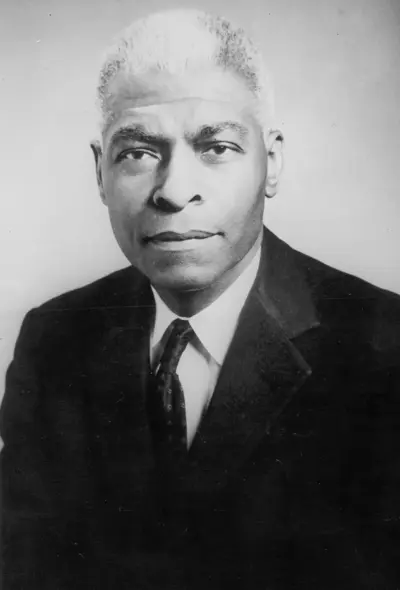
Benjamin Elijah Mays was an American Baptist minister and American rights leader who is credited with laying the intellectual foundations of the American civil rights movement. Mays taught and mentored many influential activists, including Martin Luther King Jr, Julian Bond, Maynard Jackson, and Donn Clendenon, among others. His rhetoric and intellectual pursuits focused on the spread of nonviolence and civil resistance in the mold of Mahatma Gandhi. The peak of his public influence coincided with his nearly three-decade tenure as the sixth president of Morehouse College, a historically black institution of higher learning, in Atlanta, Georgia.
