Jamie Dimon Quotes
Manipulating currencies is when you're going into the marketplace and buying something in large amounts to depress the value of the currency.
Dimon, Jamie. Interview. Bloomberg, 2015.


The assumption was that money would always be backed by gold or silver. In effect, raising or allaying the money was to change the amount of gold or silver that a particular denomination of money would be able to be exchanged for. This is one of the interesting proofs that these processes did nothing economically—for if they could, no one would want the money. This has always been a weakness or a strength—depending on one’s political point of view—of a gold standard.

President Richard Nixon, a conservative Republican did not agree with this view as it was he who led America to abandon the gold standard to back its money.

This is the first major history of banks written in the United States.

He was also the Finance Minister. In this case he was referring to China which undervalued their exchange rate. This made it easier for them to sell Chinese products abroad since buyers from abroad could buy cheaper than if the Chinese exchange rate were allowed to reach the market values. Keating and many others believe in the long run the Chinese or anyone else who tries to control their currency artificially will suffer economic consequences.


This was a very astute prediction. At the time, the United States gold mining production was second only to South Africa and American currency was based on the gold standard which seemed to all to be permanent. Half a century later, the U. S went off the gold standard.


This is the first major history of banks written in the United States.

“Pegged” exchange rates are a country’s money where the Government sets the value of the money in terms of some other currency—usually American dollars. The advantage of a pegged currency is that it is stable and does not fluctuate day to day. The disadvantage is that people realize that the value is artificial and other countries will not accept the pegged currency. Worse natives try and get as many dollars as they can because the fear that the Government will devalue and change the rate of exchange of the pegged currency.


At the time, there was no United States currency. Private banks in some of the states issued their own money. A dollar from Georgia might only be worth 75 cents in New York.

The military had made a mess of the Argentine economy and inflation was rampant. Some Argentines turned their Argentine pesos into dollars betting that the Argentine economic situation would get worse, This run from the peso would make it worse. If Argentina stabilized the peso, speculators in dollars would lose money. The Minister trying to discourage a run from the peso, warned Argentinians against the dollar investment. A days later the dollar went up over 30%. Those who had listened to the minister lost much of their money, He was soon forced to resign by the military dictators who controlled the government.

The same argument can be made against the modern paper money supply. What Jefferson and most of the founding fathers, with the exception of Alexander Hamilton. did not realize was that the major stability of any kind of money was not only the silver or gold that backed it but the political and legal stability of the nation and the size of its productive economy. Where Jefferson was right however is that all these banknotes at the time were issued by local private banks. The Government had no responsibility for paper money and had no knowledge of how much paper money any bank issues and whether or not they had any silver to back it up. Banks didn’t trust other bank’s notes and would only redeem them at a discount. A $10 note from a South Carolina bank might only be worth $7 in New York and $6 in Boston. The early American monetary system was a mess.

England compromised. They did not give up their own currency—the Pound, but they did make the Euro legal tender, so both currencies can be used in England.

What the Prime Minister was trying to say is that the buying power had not been diminished suddenly for local and non-imported items.
This is an excellent historical example of how damaging it can be for a country if its leaders do not understand the technicalities of economics and currency manipulation.
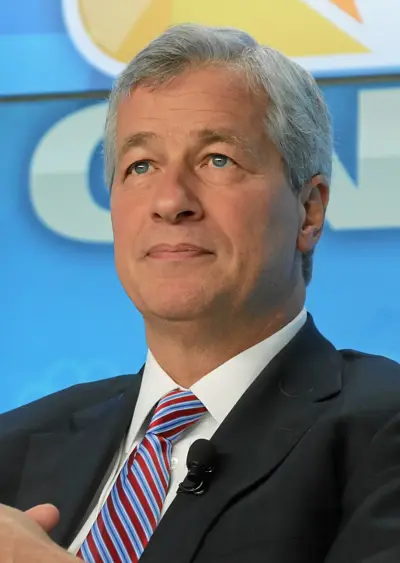
Jamie Dimon is an American billionaire businessman. He is the chairman and chief executive officer (CEO) of JPMorgan Chase, the largest of the big four American banks, since 2005 and was previously on the board of directors of the Federal Reserve Bank of New York. Dimon was included in Time magazine's 2006, 2008, 2009, and 2011 lists of the world's 100 most influential people. Dimon's net worth is estimated at $1.7 billion.
