James Connolly Quotes
Man, as a social animal, has a claim upon the society which gave him birth. This claim is his right to live as long as he is willing to perform his share of the labor necessary to his own maintenance and the maintenance of society at large. This claim involves, in the first place, the right of free access to the means of life; in the second place, the duty of contributing to the support of the weaker members of the community.
Executed by the English for his part in the Easter Uprising.
James Connolly, 1868-1916, Founder, Irish Socialist Republican Party, Military Commander of Republican Forces in Dublin, Irish Founder of the Irish Socialist Republican Party, Co-Founder Industrial Workers of the World (IWW), “Party Politicians – Noble, Ignoble and Local,” Labor Chronicle (Edinburgh), December 1, 1894
Sourced by: Eigen's Political and Historical Quotations


Normally, this would not be a particularly noteworthy quotation. However, at the time the Republican Party had shifted far to the right–more so than at any other time since its inception. The primary election he was in brought out the most right wing members of the party, which was for gutting the social safety net, did not see health care as a right, and even wanted to terminate Obamacare and Social Security as it existed. Yet when asked in a nationwide TV interview, what the government should do for the poor and destitute who could not afford health care or other necessities. His courageous answer and position doomed his bid for the presidential nomination.


This may be Kennedy’s most famous line. However he was not the first orator to express this idea however. See Khalil Gibran {601423}, Warren G. Harding {622594} and {629021}, St. John Broderick {595734}, and Oliver Wendell Holmes Jr. {603707} for earlier expressions of similar sentiments. Holmes seems to be the first to express the idea while the earliest seems similar phraseology seems to be the British Politician St. John Broderick in 1893 {595734}. Although, these earlier expressions existed, Theodore C. Sorensen, who assisted Kennedy with this speech and wrote the draft, had distilled it from earlier expressions and views of JFK and said that these were Kennedy’s words. At the time, he stated that was unaware of the Gibran, Harding, Broderick and Holmes sentiments. Gibran had not yet even been translated into English. However it is not clear whether Kennedy himself had inadvertently recollected the phrase from any of the other quotations. (The question was never put to him.) The St. John Broderick quotation is a possible source. Kennedy was quite familiar with British political history, and his father and been U. S. Ambassador to Great Britain. Regardless, the quotation was as great for the place and timing—his inaugural—as it was for the phraseology which might have originated elsewhere.

Spinoza’s ideas were considered so radical and dangerous that he was the only man in history who was excommunicated by the Catholics, the Jews and the Muslims.


This quotation might have been an inspiration for the famous JFK quotation {589867}. See Khalil Gibran {601423}, Warren G. Harding {622594} and {629021}, and Oliver Wendell Holmes Jr. {603707} for similar sentiments. Holmes preceded Broderick by a few years, but Broderick came closest to the Kennedy phraseology.


There were few reformers who had such a long, extensive, and activist career in both England and India. She began her career as a minister’s wife but was literally turned out of her house by her husband for whom she was not religiously orthodox enough. This started her religious activism which ended with her as an atheist. She led a match-girl’s strike, founded a Hindu college in India, and was even arrested for pornography in England when she wrote a book advocating birth control. She is on many lists of “Great Indians” along with Gandhi and Nehru. She was Jiddu Krishnamurti’s teacher.

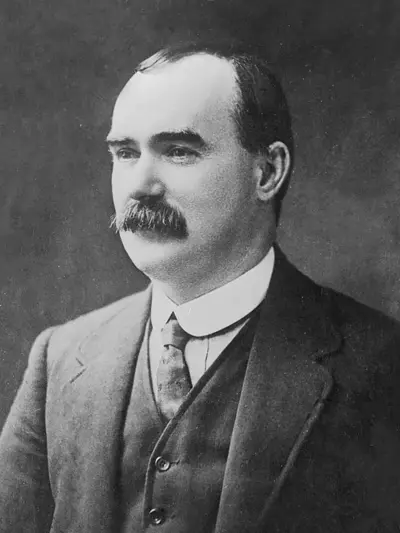
James Connolly was an Irish republican, socialist and trade union leader. Born in the Cowgate area of Edinburgh, Scotland, to Irish parents Connolly left school for working life at the age of 11, and became involved in socialist politics in the 1880s.
