Janio Quadros Quotes
Lincoln was one of history's greatest men, but Americans are not like him. He was a lonely exception.
Janio Quadros, 1917-1992, President of Brazil, Quoted in Time Magazine, June 30, 1961
Sourced by: Eigen's Political and Historical Quotations


While Douglas and Lincoln were political opponents with little love lost between them, both were patriots. Douglas’s position were much more popular in the South, and the moment he realized that Lincoln would win the Presidency, he headed South where he was very persuasive in trying to hold the Union together, but he could not see all the potential rebels and was only effective with some. South Carolina not only seceded, but in order to prevent any changing of minds, some the worst of the South Carolinians, attacked Fort Sumter firing on the American Flag and attacking and capturing the Union troops who were totally outnumbered. The Civil War was then inevitable.


This Civil War recruiting poster was described by the Free Library of Philadelphia as “Civil War recruitment print targeting African Americans by evoking the freedoms granted by the Emancipation Proclamation. Depicts a montage of symbolic scenes centered around an African American Union soldier triumphantly holding up a sword and an American flag with the banner "Freedom to the Slave." He stands near broken shackles upon a tri-color flag adorned with a coiled snake. The flag is tugged upon by one of three joyous slaves freed by an African American soldier. Other scenes depict an African American man reading a newspaper on a rocking chair near a plow and child, African American children entering a "Public School" near a church, and a regiment of "U.S. Colored Troops" marching across a battlefield strewn with dead bodies.”


Marx followed the American Civil War very closely. The freeing of the slaves caused an immediate social, moral and economic revolution, the results of which we live with today.


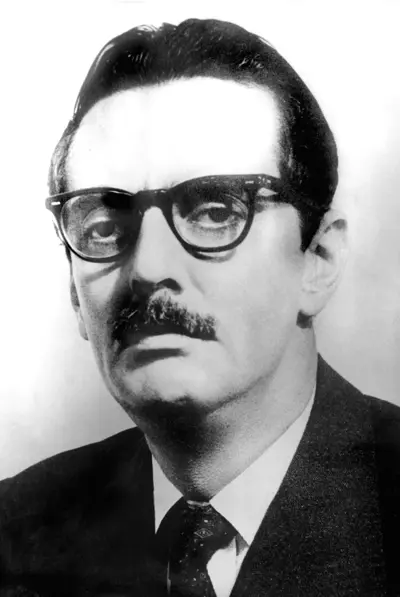
Jânio da Silva Quadros was a Brazilian lawyer and politician who served as the 22nd President of Brazil from January 31 to August 25, 1961, when he resigned from office. He also served as the 24th and 36th mayor of São Paulo, and the 18th governor of the state of São Paulo. Quadros was known for his populist style of government, honesty, and eccentric behavior. As president, he focused on economic reform and attempted to root out corruption. He also pursued an independent foreign policy, trying to balance relations between the United States and the Eastern Bloc. Although he was elected by a huge margin, his term was marked by uncertainty and political instability, culminating in his resignation. That unexpected move caused national chaos, with the presidency being assumed by João Goulart.
