Newt Gingrich Quotes
Liberals are the enemy of ordinary Americans!
Gingrich was one of the most polarizing political figures of his era. He conflated liberals with intellectuals, and people he called “elites” creating a form of class warfare where the class divisions were educational and cultural instead of socioeconomic.
Newt Gingrich, U.S. Congressman (Republican, GA), Speaker of the House, Quoted on C-SPAN Book TV, Tucson Festival of Books, March 10, 2012
Sourced by: Eigen's Political and Historical Quotations

3rd Earl Russell of Kingston. He favored and argued for a middle ground of a capitalistic socialism or a socialized capitalism, which is what most democracies became.


West, a very articulate, personable and accomplished Tea Party Candidate had won one of the 2010 congressional races in Florida. After two years in office, his rhetoric was so negative, vituperative, hateful and obviously untrue that the voters turned him out.

Actually, there have been “paranoid” fear of opposition political viewpoints in America very often. In the early days of the Republic, the Federalists main concern was not England or other foreign enemies, but Jefferson’s Democratic Republicans. And those Jeffersonians were absolutely convinced that the greatest danger to America was the Federalists who would bring back a monarchy if they could. The Jacksonians triggered a similar polarization. The Civil War stemmed from this extreme. Even America’s most popular President, Franklin Delano Roosevelt, who was elected to 4 successive terms, was perceived as the major “enemy” of America along with his wife Eleanor and the other New Dealers.

Although the Nazis railed against the Communists & Socialists, the potential opposition they feared the most was the middle class. See also {582966}.


After Roosevelt, most eras of American politics more or less followed the pattern Roosevelt described herein as a “calamity”, with the anger becoming more or less intense. Jefferson thought that these were natural divisions of politics in all societies--{604810}. The thing that masked this for years was race and slavery. In Lincoln’s time there were liberals and conservatives in both parties if race were ignored. In Theodore Roosevelt’s era, he, Taft and others were generally liberal reformers, while a large number of Republicans were conservative supporters of the status quo. Some democrats were radical reformers like William Jennings Bryan while others were arch conservatives. Until 1964 and the Civil Rights Act there were many conservatives in the Democratic Party, but almost all switched to the Republican Party in anger. The Republican conservatives tended to drive the Republican liberals out of the party and for the last part of the 20th century Roosevelt’s “calamity” well described the American political scene, and the anger increased carrying partisan bitterness into the 21st century.


Socialism in its then pure form had the state owning and controlling all the major assets of the nation. In this sense it was contradictory to individual freedom and hence democracy. However, in the years after Tocqueville’s quotation and the industrial revolution, socialism has gradually moved away from state ownership and operations of all institutions and resources. Democracy has tended to adopt a more regulatory view to control the excesses of unbridled capitalism. The range of democratic nations by the 21st century encompassed differences but some were described as “social democracies” and had some state ownership but were basically capitalistic economies. Even the self-described Communist nations had become heavily capitalistic albeit with less political freedom. At the same time, even the United States—the epitome of 21st century capitalism, owned and controlled a few of the resources and means of production and tended to regulate the others—a substantial difference from the American democracy which Tocqueville studied.


This quotation is hardly believable, even for an ultra extreme, evangelical, Christian, fundamentalist. His paranoia and homophobia went so far as to claim that somehow the only gay Congressman, Jared Polis, was going to bankrupt Christians who did not endorse his homosexuality. How he might do this Klingenschmitt never explained. But then to associate Polis with the Muslim Fundamentalist Terrorist organization ISIS—which executes homosexuals—and claim that Polis would behead Christians in America was over the top. The quotation illustrates the freedom of speech allowed in American political campaigning where the most absurd, libelous, falsehoods are allowed, as well as the fact that an obvious unbalanced person can freely run for office.

This quotation shows American tolerance and freedom of speech even for our head of state.
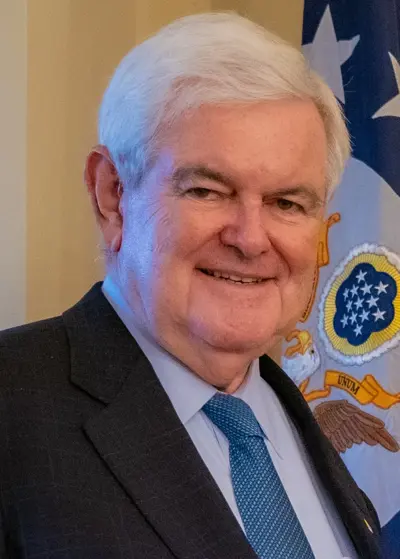
Newton Leroy Gingrich is an American politician and author who served as the 50th Speaker of the United States House of Representatives from 1995 to 1999. A member of the Republican Party, he was the U.S. Representative for Georgia's 6th congressional district serving north Atlanta and nearby areas from 1979 until his resignation in 1999. In 2012, Gingrich unsuccessfully ran for the Republican nomination for President of the United States.
