Rigoberta Menchu Quotes
Let there be freedom for the Indians, wherever they may be in the American Continent or elsewhere in the world, because while they are alive, a glow of hope will be alive as well as a true concept of life.
Menchú, Rigoberta. "Nobel Lecture." NobelPrize.org, Nobel Prize Outreach AB, 10 Dec. 1992.


This Proclamation was issued upon arrival of the British occupying imperial army in present day Iraq. The English policy makers like the Bush administration almost a century later were expecting a more welcoming reaction. See {585250}.

One of the great ironies is that she had absolute power over everyone in the Russian empire and serfdom was entrenched in Russia. However, she was far more enlightened than the Russian rulers who preceded her.


The whites had constantly encroached on the Cherokee land which was too large for any reasonable patrolling by the Indians themselves. The Federal government persuaded the Cherokee to sign a treaty by which the Indians would give up their title to the larger part of their land. The most important quid pro quo was that the Federal Government would protect the remainder of the Cherokee land from incursion by whites or even other Indians. However, whites who coveted the land started to encroach and build farms and ranches. The Federal government was reluctant to use American soldiers against American citizens and was looking for a way out. However, the Cherokee chiefs were reminding them of their obligation. The state governments were less concerned about Federal treaties, and Georgia passed a law that said that all the Cherokee land must be governed by State Law contrary to the Treaty which gave the Cherokee total sovereignty. But the Feds were not anxious to have a showdown with the states on this issue. Whites, with the connivance of the state governments and the support of some Federal Officials offered to amend the treaty with the Cherokee. The whites would pay the Indians fair market value for their land in the East. The Federal Government would provide equal amount of land in the Indian Territory of Oklahoma, then a territory. The Feds would assist with the relocation and provide troops to protect the Cherokee from thieves and raiders—whites and Indians, and would guarantee that the Cherokee would be completely sovereign in the new land. The chief’s did not want to renegotiate the old treaty—they just wanted it enforced. The Supreme Court ruled in their favor, but President Jackson, ignored the ruling and forced the Cherokee onto the Trail of Tears for Oklahoma and the whites took over the valuable Cherokee land.


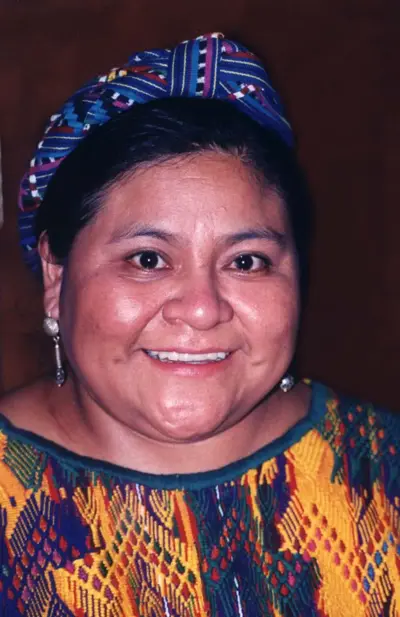
Rigoberta Menchú Tum is a K'iche' Guatemalan human rights activist, feminist, and Nobel Peace Prize laureate. Menchú has dedicated her life to publicizing the rights of Guatemala's Indigenous peoples during and after the Guatemalan Civil War (1960–1996), and to promoting Indigenous rights internationally.
