Muhammad Quotes
Let there arise out from among you a party inviting to all that is good; enjoying what is right and forbidding what is wrong: they are the ones to attain felicity
This is the quotation from the Koran which on the minds of some Muslims justifies morals police, guardians of public morals and the like which are created in some Islamic societies.
Muhammad, 571-632, Prophet and Founder of Islam, Koran, Sura 3:103
Sourced by: Eigen's Political and Historical Quotations


There is relatively little freedom of speech in Egypt and most Islamic countries where the traditional Sharia laws prohibiting blasphemy and the tradition of not publicly embarrassing the Caliph or the Sultan, combine to protect the modern Islamic state from criticism. Turkey, Tunisia and a few other Islamic states are exceptions. Under this Egyptian law anyone could be jailed for bringing “shame” to national and Islamic values. On September 6, 1981, the Egyptian Director of Public Health, Dr. Nawal El Saadawi was actually arrested and jailed for three months for saying that women were ill treated in Egypt and the rest of the Arab world. See {586710} for the kinds of statements for which Egypt would jail leading citizens.

Jacques Anatole Francois Thibault


The speech was an attempt to justify the Dirty War and the kidnappings, tortures, and killing of many citizens.

This verse has been one of the bases of Muslim theocratic states like Iran’s claim to legitimacy. The word “govern” is sometimes translated as “judge.” In the context of the 6th century, there were no separation of powers as we know them and judging, governing and legislating were melded.
Danish fundamentalist Muslim Groups were demonstrating, protesting, and threatening Danes who wrote or published cartoons depicting the Prophet Mohammed. Other Europeans who had committed what Muslims thought to be blasphemy had been attacked and even murdered by Muslim fundamentalists. Led by Nasim Rahnama, some Danish Muslims, braved attack and possible death, and produced a petition of Muslims defending the right of freedom of publication. See {59932} & {59919}.
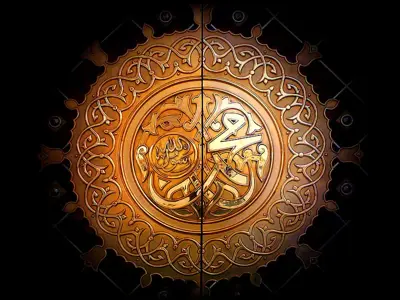
Muhammad was an Arab religious, social, and political leader and the founder of Islam. According to Islamic doctrine, he was a prophet, sent to preach and confirm the monotheistic teachings of Adam, Abraham, Moses, Jesus, and other prophets. He is believed to be the final prophet of God in all the main branches of Islam, though some modern denominations diverge from this belief. Muhammad united Arabia into a single Muslim polity, with the Quran as well as his teachings and practices forming the basis of Islamic religious belief.
