Benjamin Rush Quotes
Let the children...be carefully instructed in the principles and obligations of the Christian religion. This is the most essential part of education.
Rush, Benjamin. "To the Citizens of Philadelphia: A Plan for Free Schools." 28 Mar. 1787. Letters of Benjamin Rush, edited by L.H. Butterfield, vol. 1, Princeton University Press, 1951, p. 414.


With the exception of a few theocracies, the power to set standards of education is claimed by virtually every government in the world. Some national governments have traditionally delegated some or much of the power to state, regional or local governments. The United States has been one of the rare exceptions. The words “education” or “schools” never even appear once in the U. S. Constitution. Therefore, in the U. S. the power belongs with the state governments. (Recently with “No Child Left Behind” the U. S. Federal government has been involved in educational standards setting.) This quotation is used by many as a classic example of a practice of many right wing fundamentalist Christians and Jews who extrapolate from the Bible to determine which legislation God wants or opposes. Most Christian and Jewish clerics and theologians however reject this notion and have a more modern view of the role of God in the democratic political process. Both the United States and Canada have very small minorities who hold the Stockwell Day position. On difference however is that in the United States, such extreme fundamentalists rarely enter or succeed in politics.


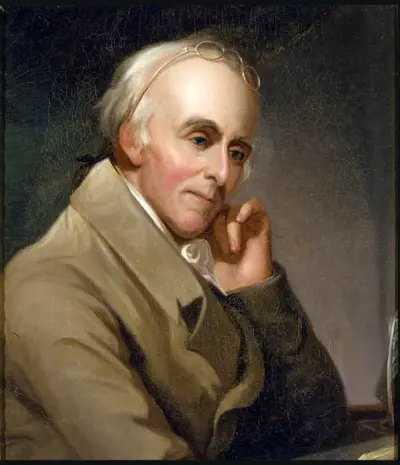
Benjamin Rush was a signer of the United States Declaration of Independence and a civic leader in Philadelphia, where he was a physician, politician, social reformer, humanitarian, and educator and the founder of Dickinson College. Rush attended the Continental Congress. His later self-description there was: "He aimed right." He served as Surgeon General of the Continental Army and became a professor of chemistry, medical theory, and clinical practice at the University of Pennsylvania.
