Leland Stanford Quotes
Legislation has been and is still directed towards the protection of wealth, rather than towards the far more important interests of labor on which everything of value to mankind depends.
Stanford, Leland. Co-operation of Labor: Speech of Hon. Leland Stanford of California in the Senate of the United States, February 16, 1887. Washington: Government Printing Office, 1887.

In 1902 there was a major coal and railroad labor crisis. The owners and operators refused to negotiate or bargain with labor: This quotation is very famous because it is an iconic picture of the views and attitudes of the large industiralists at the turn of the 20th Century. More than opposing labor unions, they actually believed that God had selected them to run the economic and business affairs of the country if not the world. It was their Christian values and paternalism that the workers should look to in order to determine the rights and priviliges of the working man or woman. This upper class attitude was one of the major reasons that class warfare broke into the open. Ironically, there was not much difference between the attidudes of the industiral leaders and the notions of fudalism.


Two years later he was assassinated.

This is a fascinating historical quotation. Karl Marx and Friedrich Engels wrote The Communist Manifesto in 1848 in England and in less than 40 years, American politicians were already in fear of the doctrine. Communism had one of the fastest spreads of any ideology. By 1886 we already see the beginnings of a Red Scare. At the time, most laws were designed to protect the wealthy and the middle class, and many discriminated against workers and the poverty stricken.


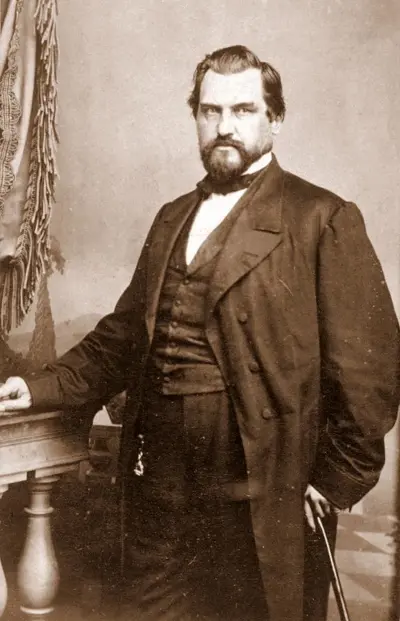
Amasa Leland Stanford was an American industrialist and politician. He was the founder (with his wife, Jane) of Stanford University. Migrating to California from New York at the time of the Gold Rush, he became a successful merchant and wholesaler, and continued to build his business empire. He spent one two-year term as Governor of California after his election in 1861, and later eight years as a United States Senator. As president of Central Pacific Railroad, beginning in 1861, and later Southern Pacific, he had tremendous power in the region and a lasting impact on California. He is widely considered a robber baron.
