Jeremy Bentham Quotes
Lawyers are the only persons in whom ignorance of the law is not punished.
Jeremy Bentham, 1748-1832, English Jurist & Philosopher, Attributed
Sourced by: Eigen's Political and Historical Quotations


Webster had been a lawyer his entire professional life and served as a distinguished Federal Judge and later as Director of the CIA and FBI. He was a stickler for adhering to the law. Casey, in contrast, was very frequently trying to get around any legal or Constitutional restrictions that might prevent him from doing what he liked. Since most of the CIA activity is secret and not amenable to oversight, his violations were not known to Congress and the public until years after his service.


If there is no rule of law, the executive, king or strongman, may handle any case in any way he wants. He can convict a poor man but let a powerful friend off. However, with the rule of law, it is the facts of the case that control, and not the identity of the law breaker. Hence the ancient Romans were somewhat suspicious of the rule of law in that it could tie the hands of the executive or magistrate and limit his discretion. To a certain extent, even modern America does not follow a completely rule of law system. The “out” is prosecutorial discretion. The prosecutors can charge one party and not bother to do so with others. An example was in 2010 when there were many bank foreclosures on home mortgages, the major banks of America were commonly committing fraud and perjury by executing legal documents allowing the forclosure, claiming that the had required documents and had done required procedure when the officers who signed the official documents had no idea what they had and just lied. The Banks had large lobbying resources, and despite the fact that felonies were committed by the tens of thousands, none of the felons was ever charged with a crime, for if they were, they were clearly guilty and there would be severe consequences. The banks promised never to do it again, and got off with none of the many guilty people ever convicted.

Perhaps this is one of the reasons American society is so litigious.


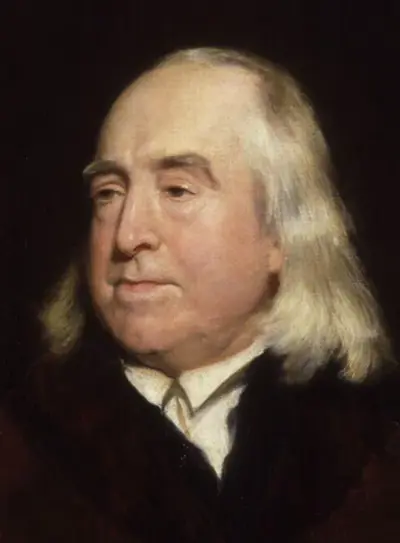
Jeremy Bentham was an English philosopher, jurist, and social reformer regarded as the founder of modern utilitarianism.
