Chief Joseph Quotes
Lawyer acted without authority from our band. He had no right to sell the Wallowa country.


Each of the original American colonies was established with a different charter and had different structures. Pennsylvania was unlike the other colonies not chartered to a company or some other structure but was given completely to William Penn as his personal property. So there was never a Royal Governor appointed by the King or a Company for Pennsylvania. Technically Penn was the "True and Absolute Proprietor" where all of Pennsylvania was treated the same as a person's personal estate in England. William Penn was a very tolerant Quaker with strong democratic, and egalitarian beliefs. He established his estate with a legislature that had the power of taxation and the making of civil laws, defense and development. He was one of the great figures in the history of America. Philadelphia was the largest city in the colonies and the center of American science and culture. However, Penn's son, Thomas Penn was everything his father despised. He was aristocratic, arrogant, power seeking, vain and greedy. However, he had inherited Pennsylvania and was the proprietor. He saw the Pennsylvania Legislature and Franklin, one of its leaders, as the people who were running his private property. So Thomas Penn at this meeting took the legal position that his father did not have the authority to establish a legislature that had power; it could only advise the proprietor. See {583431} for Thomas Penn's statement that produced this reply.

Eli Whitney, the inventor of the cotton gin, tried his hand as a gun manufacturer early in the history of the new nation. He persuaded President Thomas Jefferson that he could manufacture muskets with interchangeable parts in an era where each gun was made uniquely and there were no “spare parts.” So Whitney was the first of the American Defense Contractors. He was also the first to fail to deliver on his contract. His guns were years late and when they were finally delivered, they were very expensive and worse, not very good. The reason that this quotation is cited is that while Irvine was trying to recover the taxpayer’s money, Whitney visited the Secretaries of State and War as well as President Madison and members of Congress. The result was to give Whitney another chance and another big order for 15,000 guns. Even Whitney later admitted that these were not very good. Some argue that this quotation shows that nothing has changed much in military procurement and defense spending.


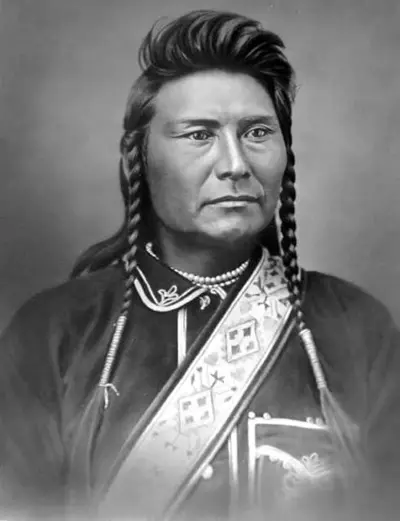
Hin-mah-too-yah-lat-kekt (or Hinmatóowyalahtq̓it in Americanist orthography), popularly known as Chief Joseph, Young Joseph, or Joseph the Younger, was a leader of the Wal-lam-wat-kain (Wallowa) band of Nez Perce, a Native American tribe of the interior Pacific Northwest region of the United States, in the latter half of the 19th century. He succeeded his father Tuekakas (Chief Joseph the Elder) in the early 1870s.
