Anthony Kennedy Quotes
Law lives in the consciousness of the people.
Anthony Kennedy, U.S. Supreme Court Justice, House Committee Testimony, March 28, 1996
Sourced by: Eigen's Political and Historical Quotations


The Senator was arguing against a bill to correct an aspect of the immigration law where infants and very young clildren are broght to the United States by parents who entered illegally. The children grow up in the United States—the only country and home that they have ever known. American law required that they be deported to “their countries” which they have no memory of and many do not even speak the language or know the culture. Sessions, is an example of the view that law defines justice. Therefore laws cannot be unjust nor can enforcing the law. Opponents point out that even in the United States we have, in earlier times, “enforced the law” which we came to regret and see as an injustice. The Fugitive slave laws, the Southern racial discrimination laws, and the law allowing Japanese American Citizens to be interned and lose their land during WWII are a few examples of laws, the enforcement of which is seen by most Americans as having been unjust. The execution of “witches” in early America was in conformity with the law.


He had visited the House of Commons. The “problems” resulted from the fact that the English had to make their own laws rather than have them provided by God as in Islamic legal systems—Sharia.


In America we do not have an official church that can morally speak for the society as a whole. As a result, we often use the law to make a moral statement even if the law is rarely enforced like prostitution. Sometimes we hear the expression, “There ought to be a law” as that is the only way we can express a societal moral value.


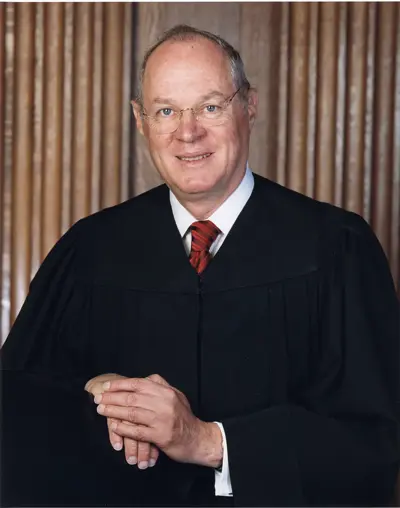
Anthony McLeod Kennedy is a retired American lawyer and jurist who served as an Associate Justice of the Supreme Court of the United States from 1988 until his retirement in 2018. He was nominated to the court in 1987 by President Ronald Reagan, and sworn in on February 18, 1988. After the retirement of Sandra Day O'Connor in 2006, he was the swing vote on many of the Roberts Court's 5–4 decisions.
