Lyndon B. Johnson Quotes
Law is the greatest human invention. All the rest give man mastery over his world, but law gives him mastery over himself.
Lyndon Baines Johnson, 1908-1973, 36th President of the United States (Democrat, TX), Speech, Conference on World Peace through Law, Washington DC, September 16, 1965
Sourced by: Eigen's Political and Historical Quotations


Note that the two do NOT ALWAYS coincide. There are those who argue that law should be respected, right or wrong. There are also those who argue that law should be respected, only when it is in the right. Note also that “respect” and “obedience” are two different things. Some people argue that law and the courts and government must have respect. Others that they are only due obedience but not necessarily respect when they are in the wrong. Still others, like Thoreau, that obedience even is not required when the law is wrong. There are those who take this to the degree that obedience to a “wrong” law is wrong and there is a DUTY to disobey a wrong law. However, a more nuanced view does not treat all laws as the same importance. I may think a particular tax is unjust and wrong, but obedience does not necessarily have moral consequences. A law that says that people with a certain religion must not be hired, however, is sufficiently immoral that I am obliged to disobey it.


This quotation of a very popular Muslim cleric illustrates the wide range of political views of Islamic leaders and authorities. Whereas most shun democracy as placing public opinion over the word of God, there are many like al-Qaradawi who have a modernist interpretation of Islam.


If there is no rule of law, the executive, king or strongman, may handle any case in any way he wants. He can convict a poor man but let a powerful friend off. However, with the rule of law, it is the facts of the case that control, and not the identity of the law breaker. Hence the ancient Romans were somewhat suspicious of the rule of law in that it could tie the hands of the executive or magistrate and limit his discretion. To a certain extent, even modern America does not follow a completely rule of law system. The “out” is prosecutorial discretion. The prosecutors can charge one party and not bother to do so with others. An example was in 2010 when there were many bank foreclosures on home mortgages, the major banks of America were commonly committing fraud and perjury by executing legal documents allowing the forclosure, claiming that the had required documents and had done required procedure when the officers who signed the official documents had no idea what they had and just lied. The Banks had large lobbying resources, and despite the fact that felonies were committed by the tens of thousands, none of the felons was ever charged with a crime, for if they were, they were clearly guilty and there would be severe consequences. The banks promised never to do it again, and got off with none of the many guilty people ever convicted.


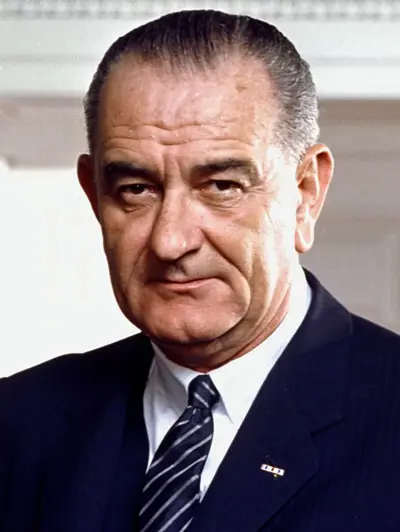
Lyndon Baines Johnson, often referred to by his initials LBJ, was the 36th president of the United States, in office from 1963 to 1969. He served as the 37th vice president from 1961 to 1963 and assumed the presidency following the assassination of President John F. Kennedy. A Democrat from Texas, Johnson was also a United States representative and later majority leader in the United States Senate. Johnson is one of only four people to have served, at various times, in all four federal elected positions.
