Jose Marti Quotes
[Latin] America began to suffer, and still suffers, from the tiresome task of reconciling the hostile and discordant elements it inherited from the despotic and perverse colonizer [Spain], and the imported methods and ideas which have been retarding logical government because they are lacking in local realities.
Jose Marti, 1853-1895, Cuban Revolutionary Leader, “Nuestra América" (1881), La Revista Ilustrada de Nueva York, January 1, 1891
Sourced by: Eigen's Political and Historical Quotations


St. Domingue was the name of Haiti which had had the only successful national slave revolt, but it was incredibly bloody with many casualties.


No one at the time knew the answer to the question but we do today. The colonial whites brought small pox with them to the new world. The whites had many generations of building immunity to small pox so that only a small percentage of whites who contracted the disease would die. The Indians, however, had never before been in contact with small pox and their immune. Their systems had not had the time to evolve resistance to the disease. The same thing occurred with the Spanish conquistadors and the native people in Central and South America only the percentage of death was much higher than the Indians of North America—possibly due to more sexual and other interpersonal contact, possibly climate, and possibly the North American Indians were better nourished and generally healthier to better withstand the disease which wiped out the vast majority of the Indians of Central and South America.
The graphic is the famous Benjamin West painting of the treaty signing between the Lenape Indians and William Penn in 1686. Tenoughan was one of the Indians depicted at the signing but we do not know which one.


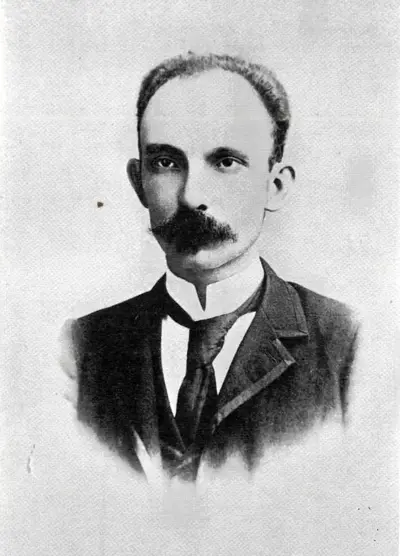
José Julián Martí Pérez was a Cuban poet, philosopher, essayist, journalist, translator, professor, and publisher, who is considered a Cuban national hero because of his role in the liberation of his country. He was also an important figure in Latin American literature. He was very politically active and is considered an important revolutionary philosopher and political theorist. Through his writings and political activity, he became a symbol of Cuba's bid for independence from the Spanish Empire in the 19th century, and is referred to as the "Apostle of Cuban Independence". From adolescence, he dedicated his life to the promotion of liberty, political independence for Cuba, and intellectual independence for all Spanish Americans; his death was used as a cry for Cuban independence from Spain by both the Cuban revolutionaries and those Cubans previously reluctant to start a revolt.
