Roland Barthes Quotes
Language is neither reactionary nor progressive; it is quite simply fascist; for fascism does not prevent speech, it compels speech.
Barthes, Roland. "Inaugural Lecture, Collège de France." A Barthes Reader, edited by Susan Sontag, Hill and Wang, 1982, p. 461.


Dodd, in Berlin from 1933 to the onset of WWII, was able to see first hand what Hitler and the Nazi Movement was really like, Although he for the United States and Churchill for England warned early on, the politics of the times would not allow any action to stop or curtail Hitler. America, in particular, had a strong isolationist Republican wing and in addition, a small but loud core of pro Fascist, Hitler admirers such as Charles Lindburg, Father Coughlin, and Henry Ford. America had virtually no serious military capacity at the time, and with the Depression, FDR had all he could do to just gradually build up the military. By the time the Democracies realized that Dodd and Churchill were right, it was too late to prevent WWII. Dodd died in 1940 just when it was clear that he had been right.


_0_thumbnail_47x47.jpg)
He was countering the argument of unlimited free speech advocates that fascist hate speech should not be countered by more speech on teh other side. Historically, he observed, that Fascism has only been defeated by force and control.


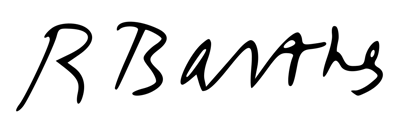
Roland Gérard Barthes was a French literary theorist, essayist, philosopher, critic, and semiotician. Barthes' ideas explored a diverse range of fields and he influenced the development of many schools of theory, including structuralism, semiotics, social theory, design theory, anthropology and post-structuralism. He was particularly known for developing and extending the field of semiotics through the analysis of a variety of sign systems, mainly derived from Western popular culture.
