Walter Russell Mead Quotes
Jacksonian common sense does not give much weight to the concept of disproportionate force, believing that if you are attacked, you have the right and even the duty to respond with overwhelming force until the enemy surrenders.
Walter Russell Mead, Editor-at-Large of The American Interest, Co-founder of the New America Foundation, Council on Foreign Relations, “The Tea Party and American Foreign Policy”, Foreign Affairs, March / April 2012
Sourced by: Eigen's Political and Historical Quotations

The United States should be One major problem at the time was that the Soviet Union was supporting and instigating revolutions in many parts of the world. When most nations of the UN wanted to provide peace keeping troops to quell the conflict, the Russians would veto and block the effort, Vandenberg wanted the UN to change the rules regarding the veto. The original right of veto for the major nations was originally included at the insistence of the United States and many Americans did not want to give it up or have any exceptions lest there be more. The Russians at that time also did not want to give up any of their veto powers. Another method that Vandenberg wanted to solve the Russian peacekeeping blockage problem was for America to engage in more collective security pacts so that action could be taken without UN Security Council unanimity by going around the UN.


Plan Orange was the code name of the united states plan for possible war with Japan. In this ironic quotation, American military planners realized five years before Pearl Harbor that surprise attack was the major vulnerability. We were surprised and had no help from our intelligence service which despite the recommendations was almost nonexistent.


This appears to be the first American utterance of a longstanding doctrine of foreign policy.

One major problem at the time was that the Soviet Union was supporting and instigating revolutions in many parts of the world. When most nations of the UN wanted to provide peace keeping troops to quell the conflict, the Russians would veto and block the effort, Vandenberg wanted the UN to change the rules regarding the veto. The original right of veto for the major nations was originally included at the insistence of the United States and many Americans did not want to give it up or have any exceptions lest there be more. The Russians at that time also did not want to give up any of their veto powers. Another method that Vandenberg wanted to solve the Russian peacekeeping blockage problem was for America to engage in more collective security pacts so that action could be taken without UN Security Council unanimity by going around the UN.


Earlier in the Arab-Israeli conflict United Nations troops were stationed at the borders to prevent either side from attacking the other. The Arabs mounted a major attack and the United Nations troops ran and did not fight. Ever since then, Israel policy was never to depend on any other than Israel to defend the country and the people.


One difficulty of diplomacy with many Islamic leaders is that the culture produces very aggressive rhetoric and very aggressive actions like Islamic terrorism. This quotation is often cited to demonstrate that it is the Iranians that had decided that America is it’s enemy; that America is to be humbled; and that their weapons development are targeted at America. This along with the most frequent Iranian slogan, “Death to America,” for many argues for preemptive military action or maintenance of a high state of readiness. Given statements like this from the leading soldier of the theocracy, there is little doubt that Iranian nuclear weapons would be a great danger to America. Therefore when Iran complains that America did not object to the fact that other nations have the nuclear bomb, they do not take their own rhetoric into account. No other nation with possible nuclear capability has made America its major military adversity and claims as an objective to humble the United States.

This is a very important quotation in that there are some who believed—then and now—narrowly that self defense is limited to responding to only physical attacks on the United States per se. Kellogg made it clear that it includes attacks on the United States and any of its possessions. Most important it allows response to any “danger” to the United States. By this definition, for example, if Saddam had been developing weapons of mass destruction in the Iraq war, the pre-emptive attack would have been self-defense. Since the claim of weapons development was bogus, it was not self defense. The key variable a reasonable danger. Nations determine that by what others do and say. In 2011, if Iran were developing nuclear weapons the U. S. could attack as an act of self defense because the Iranian highest level officials have called for “death to the United States”. When they just had the intention to harm us, there was no danger. But when they add the means to harm us to the intention, that is a danger. Likewise other nations may act in self defense if a potential enemy threatens to endanger them and has the means to carry out the threats or desires.

Nkrumah was one of the great African democrats. Like George Washington, he voluntarily relinquished his Presidency when most would have had him as a “President for Life,” or even a king. His greater vision was one of pan-Africanism. In the defense arena he didn’t realize that the major purposes of most African military was to maintain the existing regime in power unlike his own example. He further assumed that military threats would come from outside the continent as they historically had. However, virtually all the conflict in Africa has been between contending groups within a country and nearby countries taking sides and thus being drawn into the conflict.

If we replace the word “socialist” with “capitalist” this statement would be approved by almost every American Senior Military officer and Defense Official as well as most members of Congress. The reality was that the basic defense posture of the Soviet Union and the United States was essentially the same during the Cold War.

An irony is that Timosheko used German Prussian traditional military strategy to successfully defend against the German invasion of Russia.


While the President had total faith in American scientists, at the time the state of American physics was not world class in several key areas. Oppenheimer, was for example, the ONLY senior American theoretical physicist at the outbreak of the war, and he had been trained in Germany. What the President did not quite realize was how many of the key scientific positions on the Manhattan Project were foreign refugees who had fled the Nazis in Europe. Many American scientists and engineers did not want to go to Los Alamos where they could not leave for the duration of the war, had to give up their own personal research, and whose relatives who did not accompany them would never know where they were or what they were doing. But there were enough great American scientists who Oppenheimer recruited that combined with the Europeans formed the greatest and most effective concentration of scientific manpower working in history.

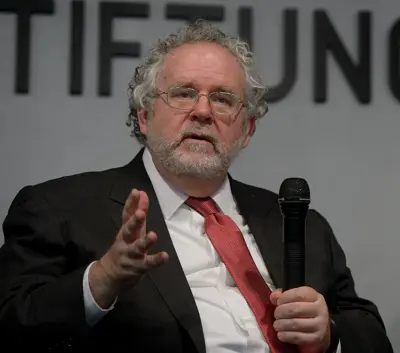
Walter Russell Mead is an American academic. He is the James Clarke Chace Professor of Foreign Affairs and Humanities at Bard College and taught American foreign policy at Yale University. He was also the editor-at-large of The American Interest magazine. Mead is a columnist for The Wall Street Journal and a scholar at the Hudson Institute.
